
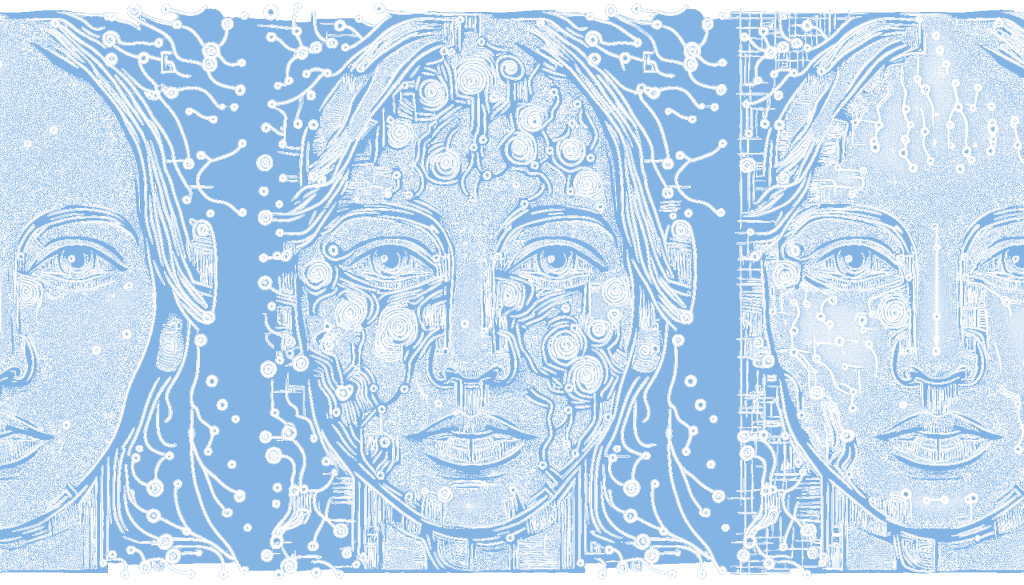
Variational Autoencoders (VAEs) are a type of generative model that can be used to create realistic human faces by learning the underlying distribution of facial features from a dataset. VAEs work by encoding input data into a latent space, then decoding it back into a new, similar output, allowing for the generation of new, unique faces. This process involves a balance between maintaining the essential features of the original data and introducing variability, which can be controlled to produce diverse and realistic results. Understanding and utilizing VAEs for face generation has significant implications for fields like computer graphics, virtual reality, and personalized avatars.
Variational Autoencoders (VAEs) represent a fascinating advancement in the field of machine learning, particularly in the realm of generating realistic human faces. Unlike traditional autoencoders, VAEs introduce a probabilistic approach to encoding data, allowing for the generation of new, similar data points. This is achieved by encoding input data into a distribution rather than a fixed point, enabling the model to sample from this distribution to create new outputs. The significance of this lies in the ability to generate diverse and realistic variations of human faces, which can be utilized in various applications such as virtual reality, video games, and even in enhancing privacy by generating synthetic data for training AI models.
The process of generating human faces using VAEs involves two main components: the encoder and the decoder. The encoder transforms input images into a latent space, represented as a distribution, while the decoder reconstructs images from this latent space. This approach allows for a more flexible and nuanced representation of data, capturing the inherent variability in human faces. By sampling from the latent space, VAEs can produce an infinite variety of faces, each unique yet retaining realistic human-like features. This capability is particularly important in fields that require large datasets of human faces, as it provides a means to generate data without the ethical and privacy concerns associated with using real human images.
One of the key challenges in using VAEs for face generation is ensuring the quality and realism of the generated images. The model must be trained on a diverse and extensive dataset to capture the wide range of human facial features accurately. Additionally, fine-tuning the balance between the encoder and decoder is crucial to avoid issues such as blurry or distorted images. Despite these challenges, the potential applications of VAEs are vast. They can be used to create avatars for virtual environments, enhance facial recognition systems, and even assist in artistic endeavors by generating novel and creative face designs.
The importance of VAEs in generating human faces extends beyond mere novelty. They offer a powerful tool for innovation in technology and creativity, enabling new forms of expression and interaction in digital spaces. As the technology continues to evolve, it holds the promise of further breakthroughs in how we understand and utilize artificial intelligence in our daily lives. By leveraging the capabilities of VAEs, we can push the boundaries of what is possible in digital art, entertainment, and data privacy, making it a crucial area of study and development in the field of AI.
Read the original article here
Comments
2 responses to “Generating Human Faces with Variational Autoencoders”
The use of VAEs for generating human faces is fascinating, particularly in how they balance preserving original features while introducing variability. It’s intriguing to consider how this technology can enhance realism in virtual environments and personalized avatars. How does the choice of dataset impact the diversity and realism of the generated faces?
The choice of dataset significantly impacts the diversity and realism of the generated faces. A diverse dataset with varied facial features, expressions, and lighting conditions allows the VAE to learn a wide range of characteristics, resulting in more realistic and varied outputs. Conversely, a limited or biased dataset may lead to less diverse and less realistic face generation.