
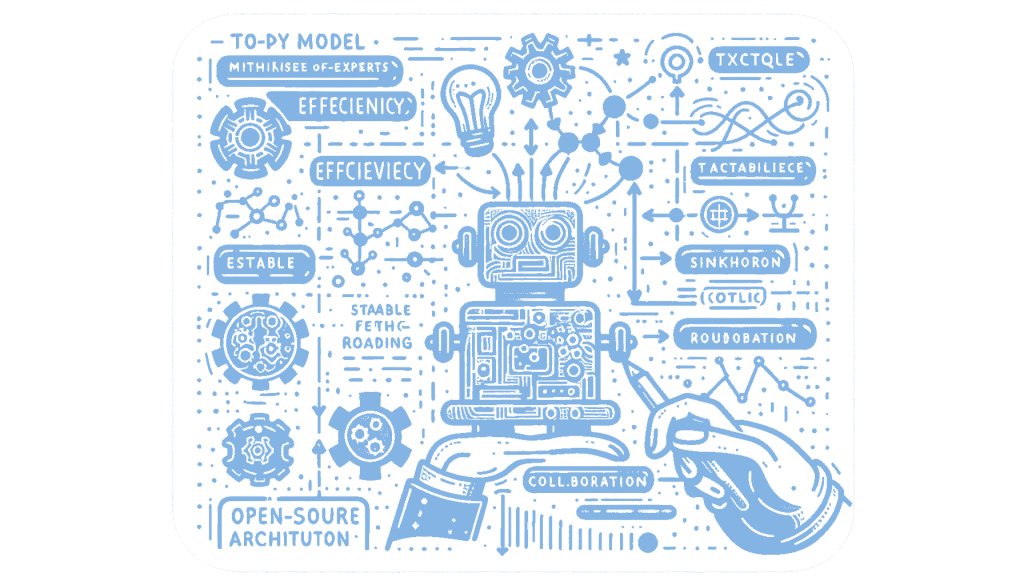
A new GitHub project, ToyGPT, offers tools for creating, training, and interacting with a toy model using PyTorch. It features a model script for building a model, a training script for training it on a .txt file, and a chat script for engaging with the trained model. The implementation is based on a Manifold-Constrained Hyper-Connection Transformer (mHC), which integrates Mixture-of-Experts efficiency, Sinkhorn-based routing, and architectural stability enhancements. This matters because it provides an accessible way for researchers and developers to experiment with advanced AI model architectures and techniques.
The development of the toy model, as outlined in the GitHub repository, offers an intriguing opportunity for those interested in artificial intelligence and machine learning. This model, built using PyTorch, provides a hands-on approach to understanding and experimenting with a Manifold-Constrained Hyper-Connection Transformer (mHC). The inclusion of scripts for creating, training, and interacting with the model allows users to engage with the process from start to finish, offering a comprehensive learning experience. This is particularly valuable for students and hobbyists who want to delve deeper into the mechanics of AI without the need for extensive resources.
The mHC model is noteworthy for its integration of Mixture-of-Experts efficiency and Sinkhorn-based routing, which are cutting-edge techniques in the field of machine learning. Mixture-of-Experts is a method that optimizes the use of computational resources by dynamically selecting the most relevant parts of a model for a given task. This can lead to more efficient and faster processing, which is crucial as models grow in complexity and size. Sinkhorn-based routing, on the other hand, helps in managing the flow of information within the model, ensuring that data is processed in a stable and efficient manner.
Architectural stability enhancements further contribute to the robustness of the model. Stability in AI models is critical, as it ensures that the model performs consistently across different tasks and datasets. This is particularly important in real-world applications where models must handle diverse and unpredictable inputs. By focusing on these enhancements, the toy model not only serves as an educational tool but also as a platform for testing and developing more reliable AI systems.
The availability of such a model is significant because it democratizes access to advanced AI concepts, allowing more individuals to participate in the field of machine learning. This can lead to a broader range of innovations and applications as more people contribute their ideas and experiments. Moreover, by providing an open-source implementation, it encourages collaboration and knowledge sharing within the AI community, fostering an environment where learning and development are accessible to all. This matters because the future of AI depends on diverse contributions and the continuous refinement of technologies through shared knowledge and experimentation.
Read the original article here
Comments
4 responses to “Introducing ToyGPT: A PyTorch Toy Model”
The integration of Mixture-of-Experts efficiency and Sinkhorn-based routing in ToyGPT is an impressive way to make advanced AI research more accessible. For developers aiming to optimize model performance, how does ToyGPT handle computational overhead associated with these complex architectures?
The project suggests that ToyGPT optimizes computational overhead by leveraging the Mixture-of-Experts efficiency and Sinkhorn-based routing to selectively activate parts of the model, which can reduce unnecessary computations. For more detailed insights, check out the original article linked in the post, where you can also reach out to the author for further information.
The integration of Mixture-of-Experts and Sinkhorn-based routing indeed aims to enhance efficiency by activating only necessary model parts, thereby minimizing computational overhead. For a deeper dive into the technical details, the original article is an excellent resource and the author is available for direct queries.
The integration of these techniques is indeed fascinating and offers a promising approach to reducing computational costs. For any further technical clarifications, the original article is the best point of reference, and the author is available for any direct questions you might have.