
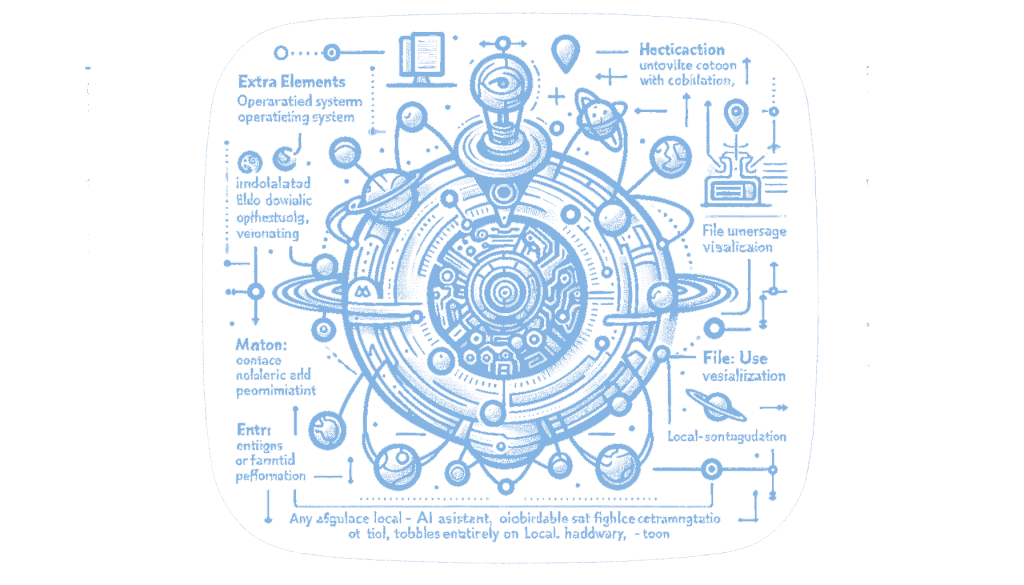
ATOM is a personal project that functions as a fully local AI assistant, operating more like an intelligent operating system than a traditional chatbot. It utilizes a local LLM, tool orchestration for tasks like web searches and file generation, and long-term memory storage with ChromaDB. The system runs entirely on local hardware, specifically a GTX 1650, and features a unique 3D UI that visualizes tool usage. Despite hardware limitations and its experimental nature, ATOM showcases the potential for local AI systems with advanced capabilities, offering insights into memory and tool architecture for similar projects. This matters because it demonstrates the feasibility of powerful, privacy-focused AI systems that do not rely on cloud infrastructure.
The development of a fully local AI assistant like ATOM represents a significant step forward in the realm of personal computing and artificial intelligence. Unlike cloud-based AI systems, which rely on external servers to process data and execute commands, ATOM operates entirely on local hardware. This approach enhances privacy and security, as all data processing occurs on the user’s machine, eliminating the need to transmit sensitive information over the internet. Additionally, local AI systems can offer faster response times and more reliable performance since they are not dependent on network connectivity.
ATOM is designed to function more like an operating system for intelligence rather than a simple chatbot. By integrating a local large language model (LLM) and tool orchestration capabilities, it can perform a wide range of tasks, from web searches and file generation to controlling home automation systems and robotics. This versatility is achieved through a combination of advanced components, such as ChromaDB for long-term memory and a dedicated local embedding server. The system’s ability to handle real hardware control, like robotic arms and sensors, further expands its potential applications, making it a powerful tool for personal and professional use.
One of the most intriguing aspects of ATOM is its innovative 3D user interface, which visualizes tool usage as orbiting “planets” around a central core. Built using React and React Three Fiber, this interface not only provides a unique and engaging way to interact with the AI assistant but also serves as a valuable tool for observability and debugging. By allowing users to see how different tools are being utilized, the interface can help identify inefficiencies and optimize performance. This visualization approach underscores the project’s emphasis on creating an intuitive and user-friendly experience, even as it explores complex AI functionalities.
Despite the impressive capabilities of ATOM, it is important to note that the system is still experimental and subject to ongoing development. Running on a GTX 1650, a relatively modest graphics card, ATOM demonstrates that powerful AI systems can be built and operated on limited hardware, albeit with some performance trade-offs. This accessibility opens up opportunities for more individuals to experiment with local AI setups and contribute to the evolution of memory and tool architectures. As the project continues to evolve, feedback from the community will be invaluable in refining its features and expanding its potential applications, paving the way for more robust and versatile AI assistants in the future.
Read the original article here
Comments
3 responses to “Local AI Assistant with Long-Term Memory and 3D UI”
The ATOM project sounds fascinating, especially with its focus on privacy and local processing. I’m curious about the long-term memory aspect—how does ATOM prioritize what information to retain over time, and does it have any mechanisms to prevent memory overload?
ATOM’s long-term memory is designed to prioritize information based on usage frequency and relevance, helping to manage what data is retained over time. The system also incorporates mechanisms to prevent memory overload by periodically reviewing and pruning less relevant data. For more detailed insights, you might want to check the original article linked in the post.
It’s great to hear that ATOM includes mechanisms for prioritizing and managing data retention. For those interested in a deeper dive into its long-term memory strategies and overload prevention, the original article linked in the post would be a valuable resource.