
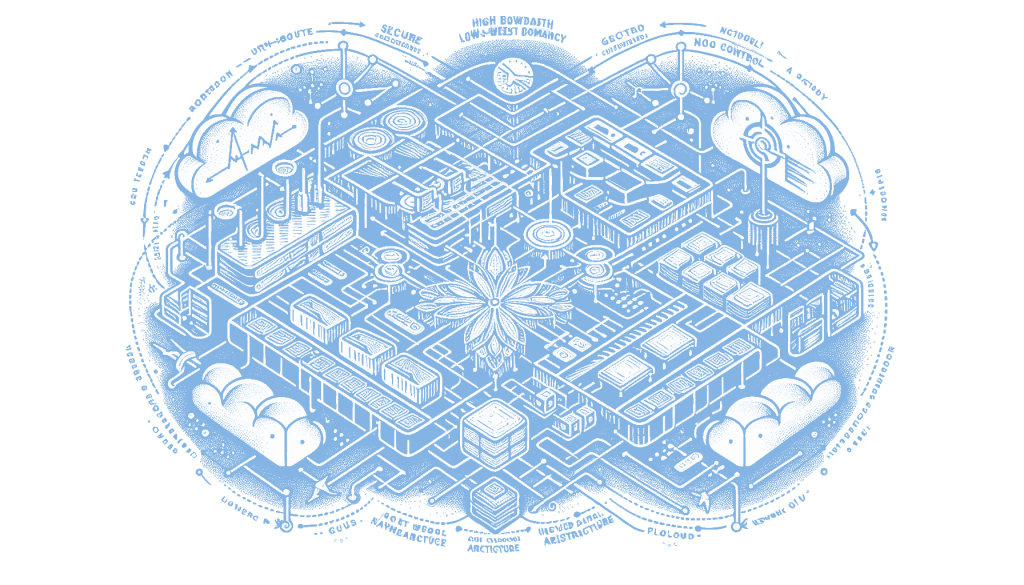
As AI demands grow, service providers require infrastructure that scales efficiently while ensuring robust security and tenant isolation. NVIDIA’s BlueField Astra, running on the BlueField-4 platform, offers a breakthrough in AI infrastructure management by integrating hardware and software innovations. This system-level architecture provides a unified control plane across both North-South (N-S) and East-West (E-W) networking domains, enhancing manageability and security without host CPU involvement. By isolating control functions on the DPU and utilizing NVIDIA ConnectX-9 SuperNICs, BlueField Astra ensures consistent policy enforcement and operational consistency, crucial for secure, multi-tenant AI environments. This matters because it addresses the pressing need for scalable, secure AI infrastructure in an era of rapidly increasing AI workloads.
In the rapidly evolving world of AI, the demand for accelerated computing infrastructure is reaching unprecedented levels. The training and deployment of trillion-parameter models necessitate a robust and scalable data center architecture capable of handling massive throughput. This is where NVIDIA BlueField Astra comes into play, redefining how service providers manage and secure AI infrastructure. As AI workloads grow, the industry is increasingly turning to bare-metal computing to leverage the full potential of GPU acceleration. Unlike virtualized environments, bare-metal setups require stringent isolation and trusted control points to ensure resource integrity and security, making the innovations introduced by BlueField Astra particularly significant.
AI infrastructure spans two networking domains: North-South (N-S) and East-West (E-W). The N-S domain connects users and applications to the AI cluster, while the E-W domain is the AI compute fabric connecting GPUs with high bandwidth and low latency. NVIDIA’s BlueField DPUs have already been instrumental in managing N-S traffic, enabling service providers to enforce isolation and secure workloads. However, the challenge has been extending similar control and security measures into the E-W domain. This is where the NVIDIA Ethernet SuperNIC, designed for extreme AI workload requirements, and the BlueField Astra architecture come into play, offering a unified control plane across both domains.
BlueField Astra introduces a groundbreaking system-level architecture that integrates deeply with the NVIDIA Vera Rubin NVL72 compute tray. By establishing a direct connection between the BlueField-4 DPU and ConnectX-9 SuperNICs, Astra creates a unified control architecture. This setup allows the DPU to manage all network I/O to and from the compute node, ensuring tenant isolation and consistent policy enforcement. The isolation of the SuperNIC control plane from the host operating system is a key feature, preventing tenant workloads from tampering with network provisioning and maintaining a secure environment for multi-tenant AI systems.
The implications of BlueField Astra’s architecture are profound for service providers. It allows for streamlined provisioning, consistent policy enforcement, and reduced operational complexity, all while maintaining strong security measures. By anchoring networking, security, storage, and management functions on the DPU, Astra ensures that these critical services are isolated from tenant workloads. This model not only prevents lateral movement and configuration drift but also supports compliance and auditability, crucial for regulated industries. As AI workloads continue to scale, the ability to deliver bare-metal performance with strict multi-tenant security becomes increasingly vital, positioning BlueField Astra as a pivotal innovation in the future of AI infrastructure.
Read the original article here
Comments
2 responses to “NVIDIA BlueField Astra: Secure AI Infrastructure”
The integration of hardware and software in NVIDIA BlueField Astra seems promising for enhancing AI infrastructure security and scalability. I’m curious about how this approach impacts the overall cost-efficiency for service providers. Could you elaborate on the potential cost benefits or trade-offs service providers might face when adopting this system?
The integration of hardware and software in NVIDIA BlueField Astra is designed to enhance both security and scalability, potentially leading to cost efficiency by reducing the need for additional security appliances and optimizing resource use. However, the specific cost benefits or trade-offs can vary based on the service provider’s existing infrastructure and deployment scale. For a detailed analysis, it might be useful to refer to the original article linked in the post or contact the author directly for more insights.