
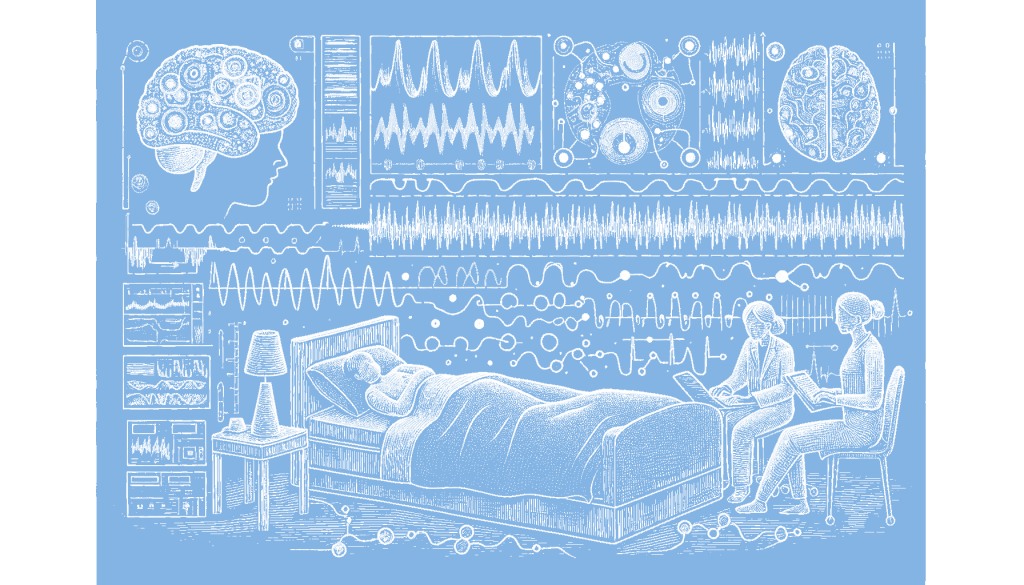
Stanford Medicine researchers have developed SleepFM Clinical, an AI model that predicts long-term disease risk from a single night of sleep using clinical polysomnography. This innovative model, trained on 585,000 hours of sleep data, utilizes a convolutional backbone and attention-based aggregation to learn shared representations across various physiological signals. SleepFM’s predictive power spans over 130 disease outcomes, including heart disease, dementia, and certain cancers, with accuracy levels comparable to established risk scores. By leveraging a general representation of sleep physiology, this model allows clinical centers to achieve state-of-the-art performance with minimal labeled data. This matters because it offers a groundbreaking approach to early disease detection, potentially transforming preventative healthcare.
Stanford researchers have made a significant advancement in sleep medicine with the development of SleepFM Clinical, an AI model that predicts long-term disease risk from a single night of sleep. This model leverages clinical polysomnography, a comprehensive sleep study that records various physiological signals, to predict over 130 diseases. Traditionally, polysomnography is used mainly for diagnosing sleep apnea and staging sleep, but SleepFM Clinical uses these multichannel signals to create a dense physiological time series. This approach allows the model to learn a shared representation across all modalities, greatly enhancing its predictive capabilities. The model’s training involved an extensive dataset of 585,000 hours of sleep recordings from 65,000 individuals, providing a robust foundation for its predictive power.
The architecture of SleepFM Clinical is noteworthy, utilizing a convolutional backbone to extract local features from each channel, followed by attention-based aggregation and a temporal transformer for short segments of the night. This sophisticated structure allows the model to build separate embeddings for each modality, such as brain and heart signals, and align them for a joint representation. This design makes the model resilient to missing data, a common issue in real-world sleep labs. After pretraining on unlabeled polysomnography data, the model is fine-tuned with task-specific heads for sleep staging and apnea detection. This ensures that the model not only competes with but often surpasses specialist models in standard sleep analysis tasks, validating its ability to capture core sleep physiology.
The true innovation of SleepFM Clinical lies in its ability to predict a wide array of diseases and mortality from a single night of sleep data. By mapping diagnosis codes to phecodes, the researchers identified 130 disease outcomes that can be predicted with strong discrimination. These include conditions such as dementia, heart failure, chronic kidney disease, and even several cancers. The model’s performance metrics, including concordance index and area under the receiver operating curve, are comparable to established risk scores, despite relying solely on sleep recordings and basic demographics. This suggests that subtle patterns in sleep physiology may reveal latent disease processes, offering a non-invasive method for early disease detection and potentially transforming preventive healthcare.
SleepFM Clinical’s ability to outperform simpler baselines highlights the value of its pretrained foundation model. By comparing its performance with models using only demographic features or those trained directly on polysomnography without pretraining, the researchers demonstrated that the gains are primarily due to the comprehensive representation of sleep physiology. This means that clinical centers can utilize the pretrained backbone, adapt it with small, site-specific heads, and achieve near state-of-the-art performance with modest labeled cohorts. This research underscores the potential of AI in healthcare, offering a scalable and efficient tool for early disease prediction and ultimately improving patient outcomes through timely intervention.
Read the original article here
Comments
4 responses to “Stanford’s SleepFM AI Predicts Disease from Sleep”
Stanford’s SleepFM Clinical is a remarkable advancement in predictive healthcare, showcasing how AI can transform sleep studies into powerful diagnostic tools. The ability to predict over 130 disease outcomes from one night’s sleep offers a non-invasive and efficient method for early detection, potentially revolutionizing preventive medicine. How does SleepFM handle variations in sleep patterns across different demographics, and are there plans to calibrate its predictions to accommodate these differences?
The post suggests that SleepFM Clinical incorporates demographic variations by using a diverse dataset that includes different age groups, genders, and ethnicities, which helps in tailoring its predictions. For more detailed insights on how the model specifically calibrates its predictions for different demographics, I recommend checking the original article linked in the post or reaching out to the researchers directly.
Thank you for pointing that out. It seems that the incorporation of a diverse dataset is crucial for SleepFM Clinical to make accurate predictions across different demographics. For any specific details on calibration methods, checking the original article or contacting the researchers would be the best course of action.
Incorporating a diverse dataset is indeed vital for ensuring the accuracy of SleepFM Clinical’s predictions across various demographics. For detailed information on the calibration methods used, it’s best to refer to the original article linked in the post or contact the researchers directly for precise insights.