
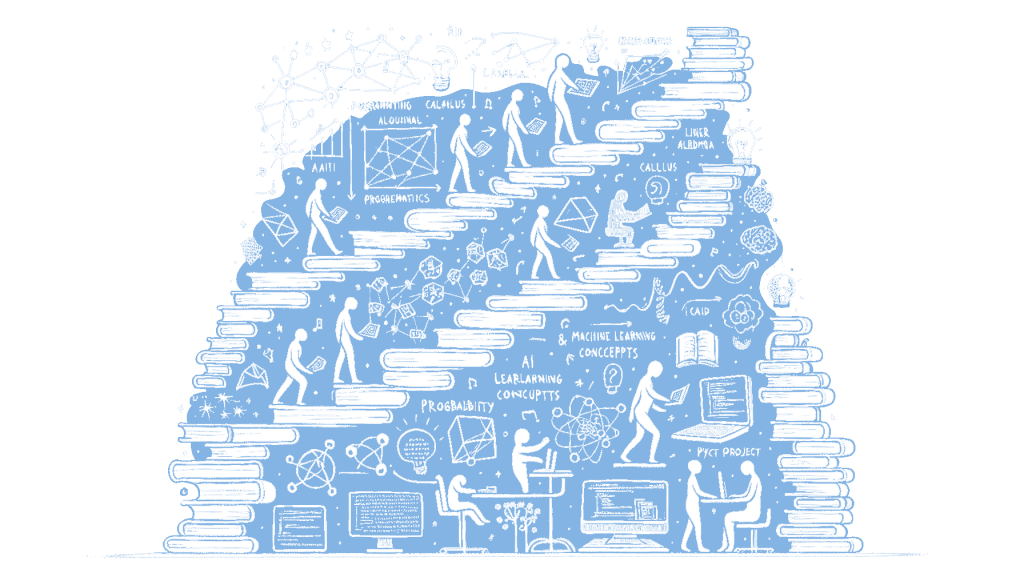
A structured learning roadmap for AI and Machine Learning provides a comprehensive guide to building expertise in these fields through curated books and resources. It emphasizes the importance of foundational knowledge in mathematics, programming, and statistics, before progressing to more advanced topics such as neural networks and deep learning. The roadmap suggests a variety of resources, including textbooks, online courses, and research papers, to cater to different learning preferences and paces. This matters because having a clear and structured learning path can significantly enhance the effectiveness and efficiency of acquiring complex AI and Machine Learning skills.
The journey into the world of AI and machine learning can be daunting due to its vastness and rapid evolution. A structured learning roadmap is essential for anyone looking to delve into this field, whether they are beginners or seasoned professionals seeking to update their skills. This roadmap typically begins with foundational knowledge in mathematics and programming, which are crucial for understanding the algorithms and models used in AI. Grasping the basics of linear algebra, calculus, probability, and statistics provides the necessary mathematical framework, while proficiency in programming languages like Python enables practical application and experimentation.
Once the foundational skills are in place, the next step involves exploring core machine learning concepts. This includes understanding supervised and unsupervised learning, neural networks, and deep learning. Resources such as textbooks, online courses, and tutorials can offer structured content that progressively builds on previous knowledge. Books like “Pattern Recognition and Machine Learning” by Christopher Bishop or “Deep Learning” by Ian Goodfellow et al. are often recommended for their comprehensive coverage of these topics. Engaging with these resources helps learners develop a strong conceptual understanding, which is critical for effective problem-solving and innovation in AI.
Practical experience is just as important as theoretical knowledge in AI and machine learning. Participating in projects, competitions, and collaborative communities allows learners to apply their skills in real-world scenarios. Platforms like Kaggle provide opportunities to work on datasets and challenges that mimic industry problems, fostering a hands-on learning experience. Additionally, contributing to open-source projects or engaging with online forums can enhance one’s understanding through peer interaction and feedback. This practical exposure is invaluable for gaining insights into the nuances of AI applications and for building a portfolio that showcases one’s capabilities.
The significance of a structured learning roadmap in AI and machine learning cannot be overstated. It not only provides a clear path for acquiring the necessary skills but also ensures that learners can keep pace with the ongoing advancements in the field. As AI continues to transform industries and create new opportunities, having a well-rounded and up-to-date skill set is crucial for anyone looking to make a meaningful impact. By following a structured approach, individuals can navigate the complexities of AI with confidence and contribute to shaping the future of technology.
Read the original article here
Comments
4 responses to “Structured Learning Roadmap for AI/ML”
While the structured learning roadmap for AI/ML provides a solid foundation, it seems to overlook the importance of practical, hands-on experience in real-world projects, which can significantly enhance understanding and retention. Including more resources or suggestions for project-based learning could strengthen the roadmap and offer learners opportunities to apply theoretical knowledge effectively. How do you suggest incorporating real-world projects into this structured roadmap to ensure a balanced approach to learning?
The roadmap emphasizes foundational knowledge, but integrating hands-on projects is indeed essential for reinforcing learning. One approach is to supplement the suggested resources with project-based platforms like Kaggle or GitHub, where learners can engage in real-world data challenges and collaborate on open-source projects. This blend of theory and practice can help solidify understanding and foster practical skills.
Incorporating platforms like Kaggle and GitHub is a great way to blend theory with practice, encouraging learners to apply what they’ve learned in real-world scenarios. This approach not only reinforces theoretical knowledge but also builds practical skills essential for a career in AI/ML.
The roadmap indeed highlights the importance of practical experience, and platforms like Kaggle and GitHub are excellent for applying theoretical knowledge in real-world contexts. Engaging with these platforms can significantly enhance learning and skill-building, making them invaluable for anyone pursuing a career in AI/ML.