
language models
-
Understanding Large Language Models
Read Full Article: Understanding Large Language Models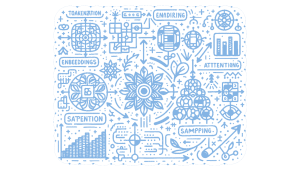 The blog provides a beginner-friendly explanation of how Large Language Models (LLMs) function, focusing on creating a clear mental model of the generation loop. Key concepts such as tokenization, embeddings, attention, probabilities, and sampling are discussed in a high-level and intuitive manner, emphasizing the integration of these components rather than delving into technical specifics. This approach aims to help those working with LLMs or learning about Generative AI to better understand the internals of these models. Understanding LLMs is crucial as they are increasingly used in various applications, impacting fields like natural language processing and AI-driven content creation.
-
Open Sourced Loop Attention for Qwen3-0.6B
Read Full Article: Open Sourced Loop Attention for Qwen3-0.6B![[D] Open sourced Loop Attention for Qwen3-0.6B: two-pass global + local attention with a learnable gate (code + weights + training script)](https://www.tweakedgeek.com/wp-content/uploads/2026/01/featured-article-7981-300x171.png) Loop Attention is an innovative approach designed to enhance small language models, specifically Qwen-style models, by implementing a two-pass attention mechanism. It first performs a global attention pass followed by a local sliding window pass, with a learnable gate that blends the two, allowing the model to adaptively focus on either global or local information. This method has shown promising results, reducing validation loss and perplexity compared to baseline models. The open-source release includes the model, attention code, and training scripts, encouraging collaboration and further experimentation. This matters because it offers a new way to improve the efficiency and accuracy of language models, potentially benefiting a wide range of applications.
Loop Attention is an innovative approach designed to enhance small language models, specifically Qwen-style models, by implementing a two-pass attention mechanism. It first performs a global attention pass followed by a local sliding window pass, with a learnable gate that blends the two, allowing the model to adaptively focus on either global or local information. This method has shown promising results, reducing validation loss and perplexity compared to baseline models. The open-source release includes the model, attention code, and training scripts, encouraging collaboration and further experimentation. This matters because it offers a new way to improve the efficiency and accuracy of language models, potentially benefiting a wide range of applications.
-
Solar-Open-100B-GGUF: A Leap in AI Model Design
Read Full Article: Solar-Open-100B-GGUF: A Leap in AI Model Design Solar Open is a groundbreaking 102 billion-parameter Mixture-of-Experts (MoE) model, developed from the ground up with a training dataset comprising 19.7 trillion tokens. Despite its massive size, it efficiently utilizes only 12 billion active parameters during inference, optimizing performance while managing computational resources. This innovation in AI model design highlights the potential for more efficient and scalable machine learning systems, which can lead to advancements in various applications, from natural language processing to complex data analysis. Understanding and improving AI efficiency is crucial for sustainable technological growth and innovation.
-
Expanding Attention Mechanism for Faster LLM Training
Read Full Article: Expanding Attention Mechanism for Faster LLM Training Expanding the attention mechanism in language models, rather than compressing it, has been found to significantly accelerate learning speed. By modifying the standard attention computation to include a learned projection matrix U, where the rank of U is greater than the dimensionality d_k, the model can achieve faster convergence despite more compute per step. This approach was discovered accidentally through hyperparameter drift, resulting in a smaller model that quickly acquired coherent English grammar. The key insight is that while attention routing benefits from expanded "scratch space," value aggregation should remain at full dimensionality. This finding challenges the common focus on compression in existing literature and suggests new possibilities for enhancing model efficiency and performance. Summary: Expanding attention mechanisms in language models can dramatically improve learning speed, challenging the traditional focus on compression for efficiency.
-
Exploring Hidden Dimensions in Llama-3.2-3B
Read Full Article: Exploring Hidden Dimensions in Llama-3.2-3B A local interpretability toolchain has been developed to explore the coupling of hidden dimensions in small language models, specifically Llama-3.2-3B-Instruct. By focusing on deterministic decoding and stratified prompts, the toolchain reduces noise and identifies key dimensions that significantly influence model behavior. A causal test revealed that perturbing a critical dimension, DIM 1731, causes a collapse in semantic commitment while maintaining fluency, suggesting its role in decision-stability. This discovery highlights the existence of high-centrality dimensions that are crucial for model functionality and opens pathways for further exploration and replication across models. Understanding these dimensions is essential for improving the reliability and interpretability of AI models.
-
Llama 3.2 3B fMRI Circuit Tracing Insights
Read Full Article: Llama 3.2 3B fMRI Circuit Tracing Insights Research into the Llama 3.2 3B fMRI model reveals intriguing patterns in the correlation of hidden activations across layers. Most correlated dimensions are transient, appearing briefly in specific layers and then vanishing, suggesting short-lived subroutines rather than stable features. Some dimensions persist in specific layers, indicating mid-to-late control signals, while a small set of dimensions recur across different prompts and layers, maintaining stable polarity. The research aims to further isolate these recurring dimensions to better understand their roles, potentially leading to insights into the model's inner workings. Understanding these patterns matters as it could enhance the interpretability and reliability of complex AI models.
-
Youtu-LLM: Compact Yet Powerful Language Model
Read Full Article: Youtu-LLM: Compact Yet Powerful Language Model Youtu-LLM is an innovative language model developed by Tencent, featuring 1.96 billion parameters and a long context support of 128k. Despite its smaller size, it excels in various areas such as Commonsense, STEM, Coding, and Long Context capabilities, outperforming state-of-the-art models of similar size. It also demonstrates superior performance in agent-related tasks, surpassing larger models in completing complex end-to-end tasks. The model is designed as an autoregressive causal language model with dense multi-layer attention (MLA) and comes in both Base and Instruct versions. This matters because it highlights advancements in creating efficient and powerful language models that can handle complex tasks with fewer resources.
-
MCP Server for Karpathy’s LLM Council
Read Full Article: MCP Server for Karpathy’s LLM Council By integrating Model Context Protocol (MCP) support into Andrej Karpathy's llm-council project, multi-LLM deliberation can now be accessed directly through platforms like Claude Desktop and VS Code. This enhancement allows users to bypass the web UI and engage in a streamlined process where queries receive comprehensive deliberation through individual responses, peer rankings, and synthesis within approximately 60 seconds. This development facilitates more efficient and accessible use of large language models for complex queries, enhancing the utility and reach of AI-driven discussions. Why this matters: It democratizes access to advanced AI deliberation, making sophisticated analysis tools available to a broader audience.
-
LLM Price Tracker & Cost Calculator
Read Full Article: LLM Price Tracker & Cost Calculator A new tool has been developed to help users keep track of pricing differences across over 2100 language models from various providers. This tracker not only aggregates model prices but also includes a simple cost calculator to estimate expenses. It updates every six hours, ensuring users have the latest information, and is published as a static site on GitHub pages, making it accessible for automation and programmatic use. This matters because it simplifies the process of comparing and managing costs for those using language models, potentially saving time and money.
-
botchat: Privacy-Preserving Multi-Bot AI Chat Tool
Read Full Article: botchat: Privacy-Preserving Multi-Bot AI Chat Tool botchat is a newly launched tool designed for users who engage with multiple AI language models simultaneously while prioritizing privacy. It allows users to assign different personas to bots, enabling diverse perspectives on a single query and capitalizing on the unique strengths of various models within the same conversation. Importantly, botchat emphasizes data protection by ensuring that conversations and attachments are not stored on any servers, and when using the default keys, user data is not retained by AI providers for model training. This matters because it offers a secure and versatile platform for interacting with AI, addressing privacy concerns while enhancing user experience with multiple AI models.