
LLMs
-
LLMs Reading Their Own Reasoning
Read Full Article: LLMs Reading Their Own Reasoning Many large language models (LLMs) that claim to have reasoning capabilities cannot actually read their own reasoning processes, as indicated by the inability to interpret tags in their outputs. Even when settings are adjusted to show raw LLM output, models like Qwen3 and SmolLM3 fail to recognize these tags, leaving the reasoning invisible to the LLM itself. However, Claude, a different LLM, demonstrates a unique ability to perform hybrid reasoning by using tags, allowing it to read and interpret its reasoning both in current and future responses. This capability highlights the need for more LLMs that can self-assess and utilize their reasoning processes effectively, enhancing their utility and accuracy in complex tasks.
-
gsh: A New Shell for Local Model Interaction
Read Full Article: gsh: A New Shell for Local Model Interaction gsh is a newly developed shell that offers an innovative way to interact with local models directly from the command line, providing features like command prediction and an agentic scripting language. It enhances user experience by allowing customization similar to neovim and supports integration with various local language models (LLMs). Key functionalities include syntax highlighting, tab completion, history tracking, and auto-suggestions, making it a versatile tool for both interactive use and automation scripts. This matters as it presents a modern approach to shell environments, potentially increasing productivity and flexibility for developers and users working with local models.
-
Exploring Active vs Total Parameters in MoE Models
Read Full Article: Exploring Active vs Total Parameters in MoE Models Major Mixture of Experts (MoE) models are characterized by their total and active parameter counts, with the ratio between these two indicating the model's efficiency and focus. Higher ratios of total to active parameters suggest a model's emphasis on broad knowledge, often to excel in benchmarks that require extensive trivia and programming language comprehension. Conversely, models with higher active parameters are preferred for tasks requiring deeper understanding and creativity, such as local creative writing. The trend towards increasing total parameters reflects the growing demand for models to perform well across diverse tasks, raising interesting questions about how changing active parameter counts might impact model performance. This matters because understanding the balance between total and active parameters can guide the selection and development of AI models for specific applications, influencing their effectiveness and efficiency.
-
Local LLMs and Extreme News: Reality vs Hoax
Read Full Article: Local LLMs and Extreme News: Reality vs Hoax The experience of using local language models (LLMs) to verify an extreme news event, such as the US attacking Venezuela and capturing its leaders, highlights the challenges faced by AI in distinguishing between reality and misinformation. Despite accessing credible sources like Reuters and the New York Times, the Qwen Research model initially classified the event as a hoax due to its perceived improbability. This situation underscores the limitations of smaller LLMs in processing real-time, extreme events and the importance of implementing rules like Evidence Authority and Hoax Classification to improve their reliability. Testing with larger models like GPT-OSS:120B showed improved skepticism and verification processes, indicating the potential for more accurate handling of breaking news in advanced systems. Why this matters: Understanding the limitations of AI in processing real-time events is crucial for improving their reliability and ensuring accurate information dissemination.
-
Semantic Grounding Diagnostic with AI Models
Read Full Article: Semantic Grounding Diagnostic with AI Models Large Language Models (LLMs) struggle with semantic grounding, often mistaking pattern proximity for true meaning, as evidenced by their interpretation of the formula (c/t)^n. This formula, intended to represent efficiency in semantic understanding, was misunderstood by three advanced AI models—Claude, Gemini, and Grok—as indicative of collapse or decay, rather than efficiency. This misinterpretation highlights the core issue: LLMs tend to favor plausible-sounding interpretations over accurate ones, which ironically aligns with the book's thesis on their limitations. Understanding these errors is crucial for improving AI's ability to process and interpret information accurately.
-
Understanding Large Language Models
Read Full Article: Understanding Large Language Models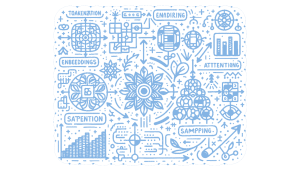 The blog provides a beginner-friendly explanation of how Large Language Models (LLMs) function, focusing on creating a clear mental model of the generation loop. Key concepts such as tokenization, embeddings, attention, probabilities, and sampling are discussed in a high-level and intuitive manner, emphasizing the integration of these components rather than delving into technical specifics. This approach aims to help those working with LLMs or learning about Generative AI to better understand the internals of these models. Understanding LLMs is crucial as they are increasingly used in various applications, impacting fields like natural language processing and AI-driven content creation.
-
Survey on Agentic LLMs
Read Full Article: Survey on Agentic LLMs![[R] Survey paper Agentic LLMs](https://www.tweakedgeek.com/wp-content/uploads/2026/01/featured-article-7984-300x171.png) Agentic Large Language Models (LLMs) are at the forefront of AI research, focusing on how these models reason, act, and interact, creating a synergistic cycle that enhances their capabilities. Understanding the current state of agentic LLMs provides insights into their potential future developments and applications. The survey paper offers a comprehensive overview with numerous references for further exploration, prompting questions about the future directions and research areas that could benefit from deeper investigation. This matters because advancing our understanding of agentic AI could lead to significant breakthroughs in how AI systems are designed and utilized across various fields.
Agentic Large Language Models (LLMs) are at the forefront of AI research, focusing on how these models reason, act, and interact, creating a synergistic cycle that enhances their capabilities. Understanding the current state of agentic LLMs provides insights into their potential future developments and applications. The survey paper offers a comprehensive overview with numerous references for further exploration, prompting questions about the future directions and research areas that could benefit from deeper investigation. This matters because advancing our understanding of agentic AI could lead to significant breakthroughs in how AI systems are designed and utilized across various fields.
-
Plano-Orchestrator: Fast Multi-Agent LLM
Read Full Article: Plano-Orchestrator: Fast Multi-Agent LLM Plano-Orchestrator is a newly launched open-source family of large language models (LLMs) designed for fast and efficient multi-agent orchestration. It acts as a supervisor agent, determining which agents should handle user requests and in what sequence, making it ideal for multi-domain scenarios like general chat, coding tasks, and long, multi-turn conversations. With a focus on privacy, speed, and performance, Plano-Orchestrator aims to enhance real-world performance and latency in agentic applications, integrating seamlessly into the Plano smart proxy server and data plane. This development is particularly significant for teams looking to improve the efficiency and safety of multi-agent systems.
-
Evaluating LLMs in Code Porting Tasks
Read Full Article: Evaluating LLMs in Code Porting Tasks The recent discussion about replacing C and C++ code at Microsoft with automated solutions raises questions about the current capabilities of Large Language Models (LLMs) in code porting tasks. While LLMs have shown promise in generating simple applications and debugging, achieving the ambitious goal of automating the translation of complex codebases requires more than just basic functionality. A test using a JavaScript program with an unconventional prime-checking function revealed that many LLMs struggle to replicate the code's behavior, including its undocumented features and optimizations, when ported to languages like Python, Haskell, C++, and Rust. The results indicate that while some LLMs can successfully port code to certain languages, challenges remain in maintaining identical functionality, especially with niche languages and complex code structures. This matters because it highlights the limitations of current AI tools in fully automating code translation, which is critical for software development and maintenance.
-
Semantic Caching for AI and LLMs
Read Full Article: Semantic Caching for AI and LLMs Semantic caching is a technique used to enhance the efficiency of AI, large language models (LLMs), and retrieval-augmented generation (RAG) systems by storing and reusing previously computed results. Unlike traditional caching, which relies on exact matching of queries, semantic caching leverages the meaning and context of queries, enabling systems to handle similar or related queries more effectively. This approach reduces computational overhead and improves response times, making it particularly valuable in environments where quick access to information is crucial. Understanding semantic caching is essential for optimizing the performance of AI systems and ensuring they can scale to meet increasing demands.