
model efficiency
-
Benchmarking 4-bit Quantization in vLLM
Read Full Article: Benchmarking 4-bit Quantization in vLLM A comprehensive analysis of vLLM quantization methods reveals varied performance across different techniques. Marlin achieved the highest token processing speed at 712 tokens per second, significantly outperforming the baseline FP16's 461 tok/s, while GPTQ without Marlin's kernel lagged behind at 276 tok/s. BitsandBytes maintained the smallest quality drop and required no pre-quantized weights, whereas GGUF had the worst perplexity but excelled in HumanEval scores. AWQ showed unexpectedly slow performance in vLLM, processing only 67 tok/s. Understanding these differences is crucial for optimizing model efficiency and performance in machine learning applications.
-
Optimizing LLMs for Efficiency and Performance
Read Full Article: Optimizing LLMs for Efficiency and Performance Large Language Models (LLMs) are being optimized for efficiency and performance across various hardware setups. The best model sizes for running high-quality, fast responses are 7B-A1B, 20B-A3B, and 100-120B MoEs, which are compatible with a range of GPUs. While the "Mamba" model design saves context space, it does not match the performance of fully transformer-based models in agentic tasks. The MXFP4 architecture, supported by mature software like GPT-OSS, offers a cost-effective way to train models by allowing direct distillation and efficient use of resources. This approach can lead to models that are both fast and intelligent, providing an optimal balance of performance and cost. This matters because it highlights the importance of model architecture and software maturity in achieving efficient and effective AI solutions.
-
R-GQA: Enhancing Long-Context Model Efficiency
Read Full Article: R-GQA: Enhancing Long-Context Model Efficiency![[Research] I implemented a routed attention mechanism (R-GQA) for faster long-context models. Then wrote a paper on it.](https://www.tweakedgeek.com/wp-content/uploads/2026/01/featured-article-9279-300x171.png) Routed Grouped-Query Attention (R-GQA) is a novel mechanism designed to enhance the efficiency of long-context models by using a learned router to select the most relevant query heads, thereby reducing redundant computations. Unlike traditional Grouped-Query Attention (GQA), R-GQA promotes head specialization by ensuring orthogonality among query heads, leading to a significant improvement in training throughput by up to 40%. However, while R-GQA shows promise in terms of speed, it falls short in performance against similar models like SwitchHead, particularly at larger scales where aggressive sparsity limits capacity. The research provides valuable insights into model efficiency and specialization, despite not yet achieving state-of-the-art status. The findings highlight the potential for improved model architectures that balance efficiency and capacity.
Routed Grouped-Query Attention (R-GQA) is a novel mechanism designed to enhance the efficiency of long-context models by using a learned router to select the most relevant query heads, thereby reducing redundant computations. Unlike traditional Grouped-Query Attention (GQA), R-GQA promotes head specialization by ensuring orthogonality among query heads, leading to a significant improvement in training throughput by up to 40%. However, while R-GQA shows promise in terms of speed, it falls short in performance against similar models like SwitchHead, particularly at larger scales where aggressive sparsity limits capacity. The research provides valuable insights into model efficiency and specialization, despite not yet achieving state-of-the-art status. The findings highlight the potential for improved model architectures that balance efficiency and capacity.
-
DeepSeek V3.2: Dense Attention Model
Read Full Article: DeepSeek V3.2: Dense Attention Model DeepSeek V3.2 with dense attention is now available for use on regular llama.cpp builds without requiring extra support. The model is compatible with Q8_0 and Q4_K_M quantization levels and can be run using a specific jinja template. Performance testing using the lineage-bench on Q4_K_M quant showed impressive results, with the model making only two errors at the most challenging graph size of 128, outperforming the original version with sparse attention. Disabling sparse attention does not seem to negatively impact the model's intelligence, offering a robust alternative for users. This matters because it highlights advancements in model efficiency and usability, allowing for broader application without sacrificing performance.
-
AI2025Dev: A New Era in AI Analytics
Read Full Article: AI2025Dev: A New Era in AI Analytics Marktechpost has launched AI2025Dev, a comprehensive analytics platform for AI developers and researchers, offering a queryable dataset of AI activities in 2025 without requiring signup. The platform includes release analytics and ecosystem indexes, featuring "Top 100" collections that connect models to research papers, researchers, startups, founders, and investors. Key features include insights into open weights adoption, agentic systems, and model efficiency, alongside a detailed performance benchmarks section for evaluating AI models. AI2025Dev aims to facilitate model selection and ecosystem mapping through structured comparison tools and navigable indexes, supporting both quick scans and detailed analyses. This matters because it provides a centralized resource for understanding AI developments and trends, fostering informed decision-making in AI research and deployment.
-
Exploring Active vs Total Parameters in MoE Models
Read Full Article: Exploring Active vs Total Parameters in MoE Models Major Mixture of Experts (MoE) models are characterized by their total and active parameter counts, with the ratio between these two indicating the model's efficiency and focus. Higher ratios of total to active parameters suggest a model's emphasis on broad knowledge, often to excel in benchmarks that require extensive trivia and programming language comprehension. Conversely, models with higher active parameters are preferred for tasks requiring deeper understanding and creativity, such as local creative writing. The trend towards increasing total parameters reflects the growing demand for models to perform well across diverse tasks, raising interesting questions about how changing active parameter counts might impact model performance. This matters because understanding the balance between total and active parameters can guide the selection and development of AI models for specific applications, influencing their effectiveness and efficiency.
-
Open Sourced Loop Attention for Qwen3-0.6B
Read Full Article: Open Sourced Loop Attention for Qwen3-0.6B![[D] Open sourced Loop Attention for Qwen3-0.6B: two-pass global + local attention with a learnable gate (code + weights + training script)](https://www.tweakedgeek.com/wp-content/uploads/2026/01/featured-article-7981-300x171.png) Loop Attention is an innovative approach designed to enhance small language models, specifically Qwen-style models, by implementing a two-pass attention mechanism. It first performs a global attention pass followed by a local sliding window pass, with a learnable gate that blends the two, allowing the model to adaptively focus on either global or local information. This method has shown promising results, reducing validation loss and perplexity compared to baseline models. The open-source release includes the model, attention code, and training scripts, encouraging collaboration and further experimentation. This matters because it offers a new way to improve the efficiency and accuracy of language models, potentially benefiting a wide range of applications.
Loop Attention is an innovative approach designed to enhance small language models, specifically Qwen-style models, by implementing a two-pass attention mechanism. It first performs a global attention pass followed by a local sliding window pass, with a learnable gate that blends the two, allowing the model to adaptively focus on either global or local information. This method has shown promising results, reducing validation loss and perplexity compared to baseline models. The open-source release includes the model, attention code, and training scripts, encouraging collaboration and further experimentation. This matters because it offers a new way to improve the efficiency and accuracy of language models, potentially benefiting a wide range of applications.
-
Expanding Attention Mechanism for Faster LLM Training
Read Full Article: Expanding Attention Mechanism for Faster LLM Training Expanding the attention mechanism in language models, rather than compressing it, has been found to significantly accelerate learning speed. By modifying the standard attention computation to include a learned projection matrix U, where the rank of U is greater than the dimensionality d_k, the model can achieve faster convergence despite more compute per step. This approach was discovered accidentally through hyperparameter drift, resulting in a smaller model that quickly acquired coherent English grammar. The key insight is that while attention routing benefits from expanded "scratch space," value aggregation should remain at full dimensionality. This finding challenges the common focus on compression in existing literature and suggests new possibilities for enhancing model efficiency and performance. Summary: Expanding attention mechanisms in language models can dramatically improve learning speed, challenging the traditional focus on compression for efficiency.
-
Hierarchical LLM Decoding for Efficiency
Read Full Article: Hierarchical LLM Decoding for Efficiency The proposal suggests a hierarchical decoding architecture for language models, where smaller models handle most token generation, while larger models intervene only when necessary. This approach aims to reduce latency, energy consumption, and costs associated with using large models for every token, by having them act as supervisors that monitor for errors or critical reasoning steps. The system could involve a Mixture-of-Experts (MoE) architecture, where a gating mechanism determines when the large model should step in. This method promises lower inference latency, reduced energy consumption, and a better cost-quality tradeoff while maintaining reasoning quality. It raises questions about the best signals for intervention and how to prevent over-reliance on the larger model. This matters because it offers a more efficient way to scale language models without compromising performance on reasoning tasks.
-
Training Models on Multiple GPUs with Data Parallelism
Read Full Article: Training Models on Multiple GPUs with Data Parallelism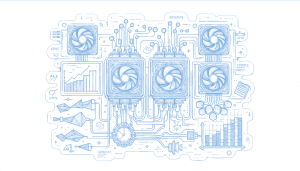 Training a model on multiple GPUs using data parallelism involves distributing data across various GPUs to enhance computational efficiency and speed. The process begins with defining a model configuration, such as the Llama model, which includes hyperparameters like vocabulary size, sequence length, and number of layers. The model utilizes components like rotary position encoding and grouped-query attention to process input data. A distributed data parallel (DDP) setup is employed to manage multiple GPUs, ensuring each GPU processes a portion of the data. The training loop involves loading data, creating attention masks, computing loss, and updating model weights using optimizers and learning rate schedulers. This approach significantly boosts training performance and is essential for handling large-scale datasets and complex models in machine learning. This matters because it enables efficient training of large models, which is crucial for advancements in AI and machine learning applications.