
simulation
-
Caterpillar and Nvidia Bring AI to Construction
Read Full Article: Caterpillar and Nvidia Bring AI to Construction Caterpillar is advancing its construction machinery by integrating AI and automation through a collaboration with Nvidia. The company is piloting an AI assistive system, called "Cat AI," in its Cat 306 CR Mini Excavator, utilizing Nvidia’s Jetson Thor AI platform. This system aids machine operators by answering questions, providing resources, offering safety tips, and scheduling services, while also collecting valuable data for simulations and operational insights. Additionally, Caterpillar is exploring digital twins of construction sites using Nvidia’s Omniverse to enhance project planning and material estimation, marking a significant step towards increased automation in their machinery lineup. This matters because it represents a significant shift towards smarter, more efficient construction processes, enhancing productivity and safety in the industry.
-
Reinforcement Learning for Traffic Efficiency
Read Full Article: Reinforcement Learning for Traffic Efficiency Deploying 100 reinforcement learning (RL)-controlled autonomous vehicles (AVs) into rush-hour highway traffic has shown promising results in smoothing congestion and reducing fuel consumption. These AVs, trained through data-driven simulations, effectively dampen "stop-and-go" waves, which are common traffic disruptions causing energy inefficiency and increased emissions. The RL agents, operating with basic sensor inputs, adjust driving behavior to maintain flow and safety, achieving up to 20% fuel savings even with a small percentage of AVs on the road. This large-scale experiment demonstrates the potential of AVs to enhance traffic efficiency without requiring extensive infrastructure changes, paving the way for more sustainable and smoother highways. This matters because it offers a scalable solution to reduce traffic congestion and its associated environmental impacts.
-
Simulate Radio Environment with NVIDIA Aerial Omniverse
Read Full Article: Simulate Radio Environment with NVIDIA Aerial Omniverse The development of 5G and 6G technology necessitates high-fidelity radio channel modeling, which is often hindered by a fragmented ecosystem where simulators and AI frameworks operate independently. NVIDIA's Aerial Omniverse Digital Twin (AODT) offers a solution by enabling researchers and engineers to simulate the physical layer components of these systems with high accuracy. AODT integrates seamlessly into various programming environments, providing a centralized computation core for managing complex electromagnetic physics calculations and enabling efficient data transfer through GPU-memory access. This facilitates the creation of dynamic, georeferenced simulations, allowing users to retrieve high-fidelity, physics-based channel impulse responses for analysis or AI training. The transition to 6G, characterized by massive data volumes and AI-native networks, benefits significantly from such advanced simulation capabilities, making AODT a crucial tool for future wireless communication development. Why this matters: High-fidelity simulations are essential for advancing 5G and 6G technologies, which are critical for future communication networks.
-
AI Physics in TCAD for Semiconductor Innovation
Read Full Article: AI Physics in TCAD for Semiconductor Innovation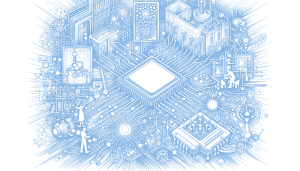 Technology Computer-Aided Design (TCAD) simulations are essential for semiconductor manufacturing, allowing engineers to virtually design and test devices before physical production, thus saving time and costs. However, these simulations are computationally demanding and time-consuming. AI-augmented TCAD, using tools like NVIDIA's PhysicsNeMo and Apollo, offers a solution by creating fast, deep learning-based surrogate models that significantly reduce simulation times. SK hynix, a leader in memory chip manufacturing, is utilizing these AI frameworks to accelerate the development of high-fidelity models, particularly for processes like etching in semiconductor manufacturing. This approach not only speeds up the design and optimization of semiconductor devices but also allows for more extensive exploration of design possibilities. By leveraging AI physics, TCAD can evolve from providing qualitative guidance to offering a quantitative optimization framework, enhancing research productivity in the semiconductor industry. This matters because it enables faster innovation and development of next-generation semiconductor technologies, crucial for advancing electronics and AI systems.
-
NVIDIA ALCHEMI: Revolutionizing Atomistic Simulations
Read Full Article: NVIDIA ALCHEMI: Revolutionizing Atomistic Simulations Machine learning interatomic potentials (MLIPs) are revolutionizing computational chemistry and materials science by enabling atomistic simulations that combine high fidelity with AI's scaling power. However, a significant challenge persists due to the lack of robust, GPU-accelerated tools for these simulations, which often rely on CPU-centric operations. NVIDIA ALCHEMI, announced at Supercomputing 2024, addresses this gap by providing a suite of high-performance, GPU-accelerated tools designed specifically for AI-driven atomistic simulations. The ALCHEMI Toolkit-Ops, part of this suite, offers accelerated operations like neighbor list construction and dispersion corrections, integrated with PyTorch for seamless use in existing workflows. ALCHEMI Toolkit-Ops employs NVIDIA Warp to enhance performance, offering a modular API accessible through PyTorch, with plans for JAX integration. This toolkit includes GPU-accelerated operations such as neighbor lists and DFT-D3 dispersion corrections, enabling efficient simulations of atomic systems. The toolkit's integration with open-source tools like TorchSim, MatGL, and AIMNet Central further enhances its utility, allowing for high-throughput simulations and improved computational efficiency without sacrificing accuracy. Benchmarks demonstrate its superior performance compared to existing kernel-accelerated models, making it a valuable resource for researchers in chemistry and materials science. Getting started with ALCHEMI Toolkit-Ops is straightforward, requiring Python 3.11+, a compatible operating system, and an NVIDIA GPU. Installation is facilitated via pip, and the toolkit is designed to integrate seamlessly with the broader PyTorch ecosystem. Key features include high-performance neighbor lists, DFT-D3 dispersion corrections, and long-range electrostatic interactions, all optimized for GPU computation. These capabilities enable accurate modeling of interactions critical for molecular simulations, providing a powerful tool for researchers. The toolkit's ongoing development promises further enhancements, making it a significant advancement in the field of computational chemistry and materials science. This matters because it accelerates research and development in these fields, potentially leading to breakthroughs in material design and drug discovery.