
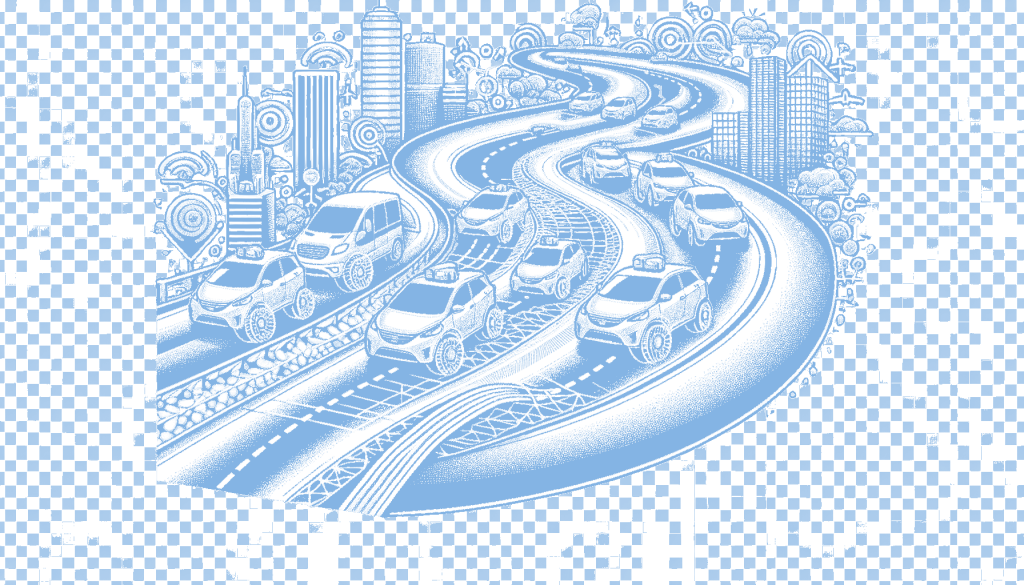
Deploying 100 reinforcement learning (RL)-controlled autonomous vehicles (AVs) into rush-hour highway traffic has shown promising results in smoothing congestion and reducing fuel consumption. These AVs, trained through data-driven simulations, effectively dampen “stop-and-go” waves, which are common traffic disruptions causing energy inefficiency and increased emissions. The RL agents, operating with basic sensor inputs, adjust driving behavior to maintain flow and safety, achieving up to 20% fuel savings even with a small percentage of AVs on the road. This large-scale experiment demonstrates the potential of AVs to enhance traffic efficiency without requiring extensive infrastructure changes, paving the way for more sustainable and smoother highways. This matters because it offers a scalable solution to reduce traffic congestion and its associated environmental impacts.
The deployment of 100 reinforcement learning (RL)-controlled autonomous vehicles (AVs) on a highway to smooth traffic and reduce fuel consumption is a significant step forward in addressing the pervasive problem of “stop-and-go” waves. These waves are common in dense traffic and result from small fluctuations in driver behavior that amplify over time, leading to congestion, increased fuel consumption, and higher CO2 emissions. Traditional methods like ramp metering and variable speed limits require costly infrastructure and centralized control, making them less scalable. The use of AVs equipped with RL controllers offers a promising alternative, as they can dynamically adjust their driving behavior in real-time to improve traffic flow and energy efficiency.
Reinforcement learning is a powerful tool in this context, as it allows AVs to learn optimal driving strategies through trial and error interactions with their environment. By training RL agents in fast, data-driven simulations that replicate real-world traffic dynamics, these AVs can learn to dampen stop-and-go waves and reduce fuel consumption for both themselves and nearby human-driven vehicles. The simulations used in this project were based on experimental data from Interstate 24 near Nashville, Tennessee, ensuring that the RL agents were trained in a realistic environment. This approach allows AVs to operate using only basic sensor information, making it possible to deploy these controllers on most modern vehicles without additional infrastructure.
The design of the reward function for the RL agents is crucial, as it must balance multiple objectives, including wave smoothing, energy efficiency, safety, driving comfort, and adherence to human driving norms. By carefully tuning the reward function, the RL agents can learn to maintain slightly larger gaps than human drivers, which helps absorb abrupt traffic slowdowns more effectively. In simulations, this approach has resulted in significant fuel savings, with up to 20% reductions in the most congested scenarios. Importantly, the AVs used in these tests were standard consumer vehicles equipped with smart adaptive cruise control, demonstrating that these benefits can be achieved without the need for specialized vehicles.
The large-scale field test, known as the MegaVanderTest, successfully deployed 100 RL-controlled vehicles on I-24 during peak traffic hours, marking the largest mixed-autonomy traffic-smoothing experiment conducted to date. The results showed a trend of reduced fuel consumption around the AVs, consistent with simulation predictions. This decentralized approach, which does not rely on explicit cooperation or communication between AVs, reflects the current state of autonomy deployment and highlights the potential for further improvements. Future advancements could include faster and more accurate simulations, better human-driving models, and the integration of additional traffic data. As more vehicles are equipped with smart traffic-smoothing controls, we can expect to see fewer traffic waves, reduced pollution, and significant fuel savings for all road users. This experiment represents a crucial step towards more efficient and sustainable transportation systems.
Read the original article here