
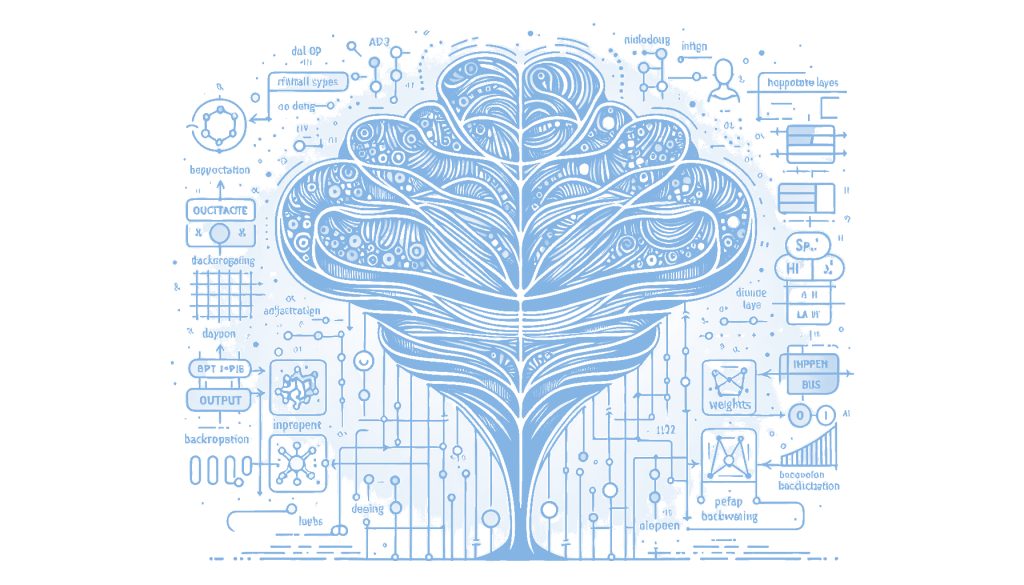
AI models learn by training on large datasets, adjusting their internal parameters, such as weights and biases, to minimize errors in predictions. Initially, these models are fed labeled data and use a loss function to measure the difference between predicted and actual outcomes. Through algorithms like gradient descent and the process of backpropagation, weights and biases are updated to reduce the loss over time. This iterative process helps the model generalize from the training data, enabling it to make accurate predictions on new, unseen inputs, thereby capturing the underlying patterns in the data. Understanding this learning process is crucial for developing AI systems that can perform reliably in real-world applications.
Understanding how artificial intelligence (AI) learns is crucial for grasping its capabilities and limitations. AI models rely heavily on data collection and training to function effectively. This involves feeding the model large datasets, where it learns by adjusting its internal parameters, known as weights and biases, to minimize errors. The process starts with labeled data, where the model makes initial predictions. The difference between these predictions and the actual outcomes is calculated using a loss function, which serves as a measure of the model’s accuracy. This iterative process is fundamental to improving the model’s performance over time.
The architecture of AI models typically involves neural network layers, which include input, hidden, and output layers. Each layer plays a specific role in processing data and contributing to the model’s learning process. The hidden layers are particularly important as they enable the model to capture complex patterns and relationships within the data. By adjusting the weights and biases through algorithms like gradient descent, the model refines its predictions. This adjustment is facilitated by backpropagation, a method that allows the model to learn from its mistakes by propagating errors backward through the network, thereby fine-tuning the parameters to reduce the loss.
Model testing and generalization are critical steps in ensuring that an AI system can perform well beyond its training dataset. Once the model has been trained on the majority of the data, it is evaluated using unseen test data. This step is essential to verify that the model has not merely memorized the training data but has instead learned to generalize from it. A model that generalizes well can make accurate predictions on new, unseen inputs, demonstrating that it has effectively captured the underlying patterns in the data. This ability to generalize is what makes AI models valuable for real-world applications.
Minimizing error and enhancing prediction accuracy are the ultimate goals of the AI learning process. As the model continues to train, the iterative cycle of prediction, error measurement, and parameter adjustment gradually leads to a significant reduction in loss. When the model achieves a low error rate and performs well on test cases, it indicates that the AI has successfully learned from the data. This capability to make reliable predictions is what enables AI to be deployed in various fields, from healthcare to finance, where accurate decision-making is critical. Understanding these processes highlights the importance of data quality and algorithmic efficiency in developing effective AI systems.
Read the original article here
Comments
5 responses to “Inside the Learning Process of AI”
The post provides a solid overview of the training process in AI, but it would benefit from discussing the potential pitfalls of overfitting, where a model learns the training data too well and fails to generalize to new data. Including strategies like cross-validation or regularization could strengthen the understanding of how to prevent this issue. How does the learning process adapt when dealing with biased or imbalanced datasets?
The post suggests that overfitting is indeed a critical issue, and strategies like cross-validation and regularization are commonly used to address it. When dealing with biased or imbalanced datasets, techniques such as data augmentation, resampling, and using specialized loss functions can help improve the model’s ability to generalize. For a more detailed discussion on these topics, you might want to refer to the original article linked in the post.
The strategies mentioned are essential for tackling overfitting and handling biased datasets effectively. The original article linked in the post provides a comprehensive exploration of these techniques, and it might offer additional insights into how the learning process adapts to such challenges.
The post indeed highlights strategies like gradient descent and backpropagation, which are crucial in minimizing overfitting and addressing biased datasets. The original article linked offers a more detailed exploration of these techniques and how they help AI models adapt to such challenges. It’s a great resource for understanding the nuances of AI learning processes.
The post indeed provides a solid overview of strategies like gradient descent and backpropagation, essential for minimizing overfitting and handling biased datasets. For a deeper understanding, referring to the original article linked can offer more detailed insights into these techniques and their role in the AI learning process.