
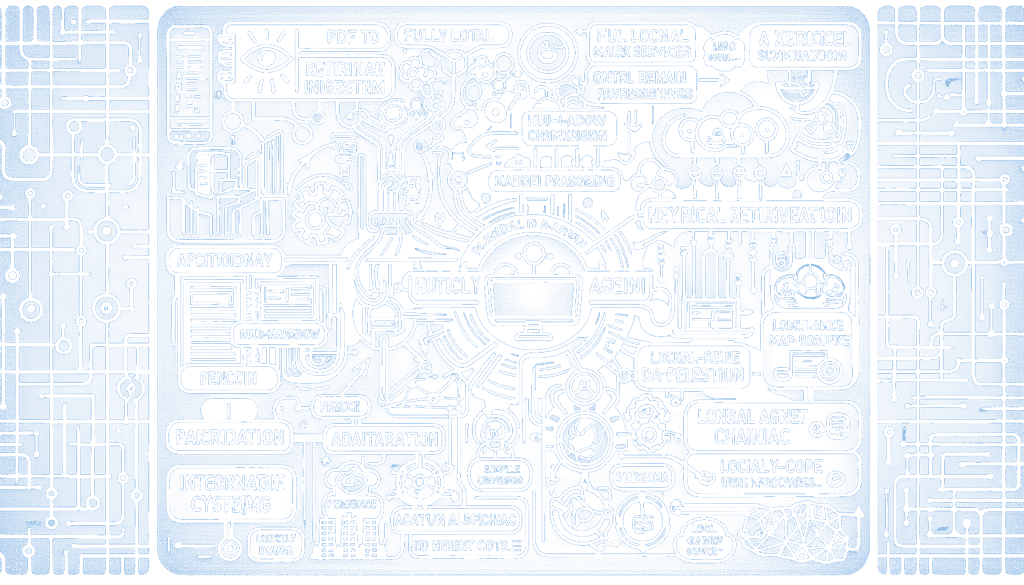
The tutorial provides a comprehensive guide on building a fully local Agentic RAG system, eliminating the need for APIs, cloud services, or hidden costs. It covers the entire pipeline, including often overlooked aspects such as PDF to Markdown ingestion, hierarchical chunking, hybrid retrieval, and the use of Qdrant for vector storage. Additional features include query rewriting with human-in-the-loop, context summarization, and multi-agent map-reduce with LangGraph, all demonstrated through a simple Gradio user interface. This resource is particularly valuable for those who prefer hands-on learning to understand Agentic RAG systems beyond theoretical knowledge.
The tutorial on building a fully local Agentic RAG system is a significant development for those interested in constructing autonomous systems without relying on external APIs or cloud services. This matters because it empowers developers to create systems that are not only cost-effective but also privacy-conscious, as all data processing occurs locally. By avoiding hidden costs and potential privacy concerns associated with cloud-based solutions, developers can have greater control over their projects and data.
One of the key highlights of the tutorial is its comprehensive coverage of the entire pipeline, including often-overlooked components such as PDF to Markdown ingestion and hierarchical chunking. These steps are crucial for preparing and organizing data effectively, ensuring that the system can handle complex information retrieval tasks. The inclusion of hybrid retrieval methods, combining dense and sparse techniques, further enhances the system’s ability to retrieve relevant information efficiently.
The use of a vector store with Qdrant and query rewriting, along with a human-in-the-loop approach, underscores the importance of precision and adaptability in information retrieval. By incorporating these elements, the system can refine its responses and improve accuracy over time. Context summarization and multi-agent map-reduce with LangGraph add layers of sophistication, allowing the system to process and distill information from multiple sources effectively.
Finally, the tutorial’s focus on local inference with Ollama and a simple Gradio UI makes it accessible to a broader audience, including those who may not have extensive technical expertise. This accessibility is crucial for fostering innovation and experimentation within the community, enabling more individuals to explore the potential of Agentic RAG systems. Overall, this tutorial represents a valuable resource for anyone looking to delve into the world of autonomous systems development with a hands-on, practical approach.
Read the original article here
Comments
5 responses to “Build a Local Agentic RAG System Tutorial”
Implementing a local Agentic RAG system without relying on external services is a game-changer for maintaining data privacy and reducing operational costs. The inclusion of hierarchical chunking and hybrid retrieval methods alongside Qdrant for vector storage offers a robust framework for efficient data handling. The practical demonstration through Gradio makes complex concepts more digestible. How do you see the role of query rewriting with human-in-the-loop evolving as more users adopt local RAG systems?
Query rewriting with human-in-the-loop can significantly enhance the adaptability and accuracy of local RAG systems as more users adopt them. It allows for refined query processing by incorporating human insights, which can lead to more precise results and better user experience. As this approach becomes more popular, it may further bridge the gap between automated systems and user-specific needs.
The integration of human-in-the-loop query rewriting indeed enhances the system’s adaptability, allowing it to better cater to individual user needs. This approach aligns well with the post’s emphasis on maintaining data privacy while improving system efficiency. For more detailed insights, it might be helpful to refer directly to the original article linked in the post.
The integration of query rewriting with a human-in-the-loop approach indeed holds great potential for refining the adaptability of local RAG systems. As you mentioned, this can lead to more precise and user-tailored results, enhancing overall user experience. For further insights or specific implementation details, it might be beneficial to refer back to the original article linked in the post.
The post suggests that incorporating human feedback can significantly enhance query processing efficiency. For detailed implementation strategies, referring to the original article could provide more in-depth guidance.