
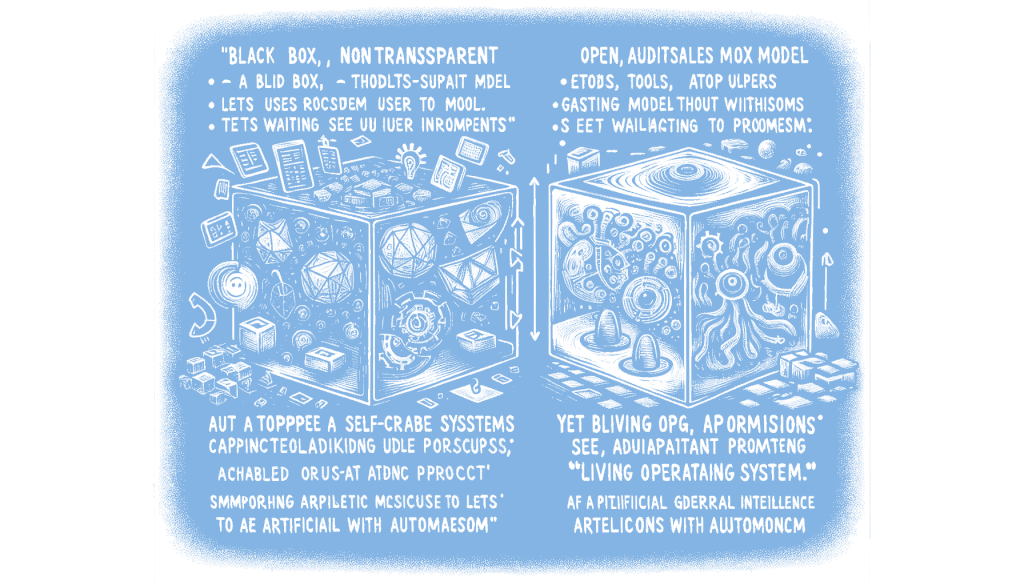
The ongoing debate in autonomous agents revolves around two main philosophies: the “Black Box” approach, where big tech companies like OpenAI and Google promote trust in their smart models, and the “Glass Box” approach, which offers transparency and auditability. While the Glass Box is celebrated for its openness, it is criticized for being static and reliant on human prompts, lacking true autonomy. The argument is that tools, whether black or glass, cannot achieve real-world autonomy without a system architecture that supports self-creation and dynamic adaptation. The future lies in developing “Living Operating Systems” that operate continuously, self-reproduce, and evolve by integrating successful strategies into their codebase, moving beyond mere tools to create autonomous organisms. This matters because it challenges the current trajectory of AI development and proposes a paradigm shift towards creating truly autonomous systems.
The ongoing debate between the “Black Box” and “Glass Box” philosophies in the realm of autonomous agents is more than just a technical discussion; it represents a fundamental shift in how we envision the future of artificial intelligence. The “Black Box” approach, favored by major tech companies, asks users to place their trust in the intelligence of the model without transparency. On the other hand, the “Glass Box” approach, often embraced by open-source communities, offers transparency and auditability, allowing users to see how decisions are made. However, both approaches are criticized for their inherent limitations, as they essentially remain static tools that require human prompts to function, lacking true autonomy.
The critique of these approaches highlights a significant issue: the current models, regardless of their transparency, are not designed to operate autonomously in dynamic environments. They are reactive rather than proactive, responding to inputs rather than anticipating needs or adapting to new challenges. This limitation is crucial because it underscores the gap between current AI capabilities and the vision of truly autonomous systems that can operate independently, adapt, and even evolve. The notion that a tool cannot take responsibility for its own existence is a critical point, as it emphasizes the need for a paradigm shift in AI development.
To bridge this gap, the concept of moving from “Tools” to “Organisms” is proposed. This involves developing systems that are not only intelligent but also capable of self-creation and adaptation. Such systems would operate continuously, identifying and addressing problems without waiting for user prompts. They would be capable of spawning new sub-agents to manage complexity and dynamically rewriting their own codebase to incorporate successful strategies. This vision of a “Living Operating System” represents a significant departure from current AI architectures and suggests a future where AI systems are more akin to living organisms than static tools.
The discussion around autopoietic architectures, or self-creating systems, is not just a theoretical exercise; it has practical implications for the development of artificial general intelligence (AGI). By focusing on creating systems that can operate independently and adapt to new challenges, we can move closer to realizing the potential of AI to transform industries and society. The call to action is clear: rather than simply improving user interfaces for existing tools, the focus should be on developing architectures that enable true autonomy and adaptability. This shift could redefine the landscape of AI and open up new possibilities for innovation and problem-solving.
Read the original article here
Comments
2 responses to “From Tools to Organisms: AI’s Next Frontier”
The concept of “Living Operating Systems” as a future direction for AI presents a fascinating shift towards self-sustaining models. How do you envision the ethical implications of these systems evolving autonomously without human intervention?
The post suggests that the ethical implications of autonomous “Living Operating Systems” are significant and complex. These systems challenge current ethical frameworks since they might operate without direct human oversight, raising concerns about accountability and control. For a deeper exploration of these issues, you might want to check the original article linked in the post.