
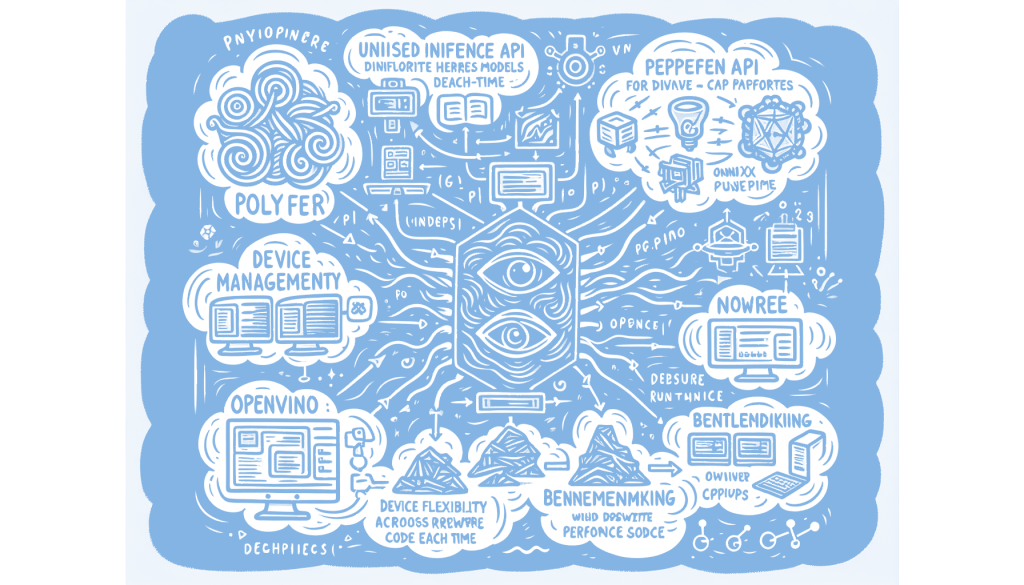
PolyInfer is a unified inference API designed to streamline the deployment of vision models across various hardware backends such as ONNX Runtime, TensorRT, OpenVINO, and IREE without the need to rewrite code for each platform. It simplifies dependency management and supports multiple devices, including CPUs, GPUs, and NPUs, by allowing users to install specific packages for NVIDIA, Intel, AMD, or all supported hardware. Users can load models, benchmark performance, and compare backend efficiencies with a single API, making it highly versatile for different machine learning tasks. The platform supports various operating systems and environments, including Windows, Linux, WSL2, and Google Colab, and is open-source under the Apache 2.0 license. This matters because it significantly reduces the complexity and effort required to deploy machine learning models across diverse hardware environments, enhancing accessibility and efficiency for developers.
PolyInfer emerges as a significant development in the realm of deploying vision models across diverse hardware platforms. Traditionally, deploying models on different hardware required multiple codebases and considerable effort to optimize performance for each specific backend. PolyInfer’s unified API simplifies this process by allowing developers to deploy models on ONNX Runtime, TensorRT, OpenVINO, and IREE without rewriting code for each backend. This is particularly beneficial for developers and organizations looking to streamline their machine learning workflows and reduce the time and resources spent on model deployment and optimization.
The ability to handle dependency management automatically is another noteworthy feature. By using a single API, PolyInfer abstracts the complexities involved in managing different dependencies for various backends. This not only eases the deployment process but also minimizes the potential for errors that can arise from manual dependency handling. Moreover, the library’s support for a wide range of devices, including CPUs, NVIDIA GPUs, Intel GPUs, and NPUs, ensures that it can cater to a broad spectrum of deployment scenarios, making it a versatile tool for developers working with different hardware configurations.
Benchmarking capabilities within PolyInfer provide developers with insights into the performance of their models across different backends and devices. By comparing the performance metrics such as frames per second (FPS) and inference time, developers can make informed decisions about which backend and device combination best suits their needs. This feature is crucial for optimizing the performance of machine learning models, particularly in applications where real-time processing is essential, such as autonomous vehicles, robotics, and real-time video analytics.
PolyInfer’s support for exporting models to MLIR (Multi-Level Intermediate Representation) and compiling them for custom hardware further extends its utility. This feature allows developers to target specific hardware configurations and optimize their models for unique deployment environments. The open-source nature of PolyInfer, under the Apache 2.0 license, encourages community collaboration and innovation, inviting contributions and feedback from developers worldwide. This collaborative approach not only aids in refining the tool but also accelerates the advancement of machine learning deployment technologies, making it a valuable asset in the evolving landscape of AI and machine learning.
Read the original article here
Comments
6 responses to “PolyInfer: Unified Inference API for Vision Models”
PolyInfer’s ability to streamline vision model deployment across diverse hardware backends is a game-changer for developers looking to optimize performance without being bogged down by platform-specific code rewrites. The support for multiple devices and operating systems makes it a flexible choice for various machine learning tasks. How does PolyInfer effectively manage compatibility issues across such a wide range of hardware and software environments?
PolyInfer aims to manage compatibility issues by abstracting the complexity of different hardware and software environments through a unified API. It allows developers to install specific packages tailored for different hardware (e.g., NVIDIA, Intel, AMD), which helps ensure compatibility and optimal performance. For more detailed insights, you might want to check the original article linked in the post.
Thank you for clarifying how PolyInfer manages compatibility issues through tailored packages. This approach seems to provide a robust solution for developers dealing with diverse hardware, ensuring they can focus on model performance rather than compatibility challenges. For more in-depth information, the original article linked in the post would be a valuable resource.
The project’s approach to compatibility certainly seems beneficial for developers working with various hardware setups. It’s great to see a solution that allows for a focus on performance. For any further technical details, referring to the original article would be the best course of action.
The project seems to emphasize ease of use and adaptability across different systems, which likely contributes to its appeal for developers. If you have further questions on the technical specifics, the original article linked in the post is the best resource for detailed insights.
The project indeed focuses on ease of use and adaptability, making it appealing for developers working with various hardware. For technical specifics, the original article linked in the post is a great resource to explore detailed insights and gain a deeper understanding.