
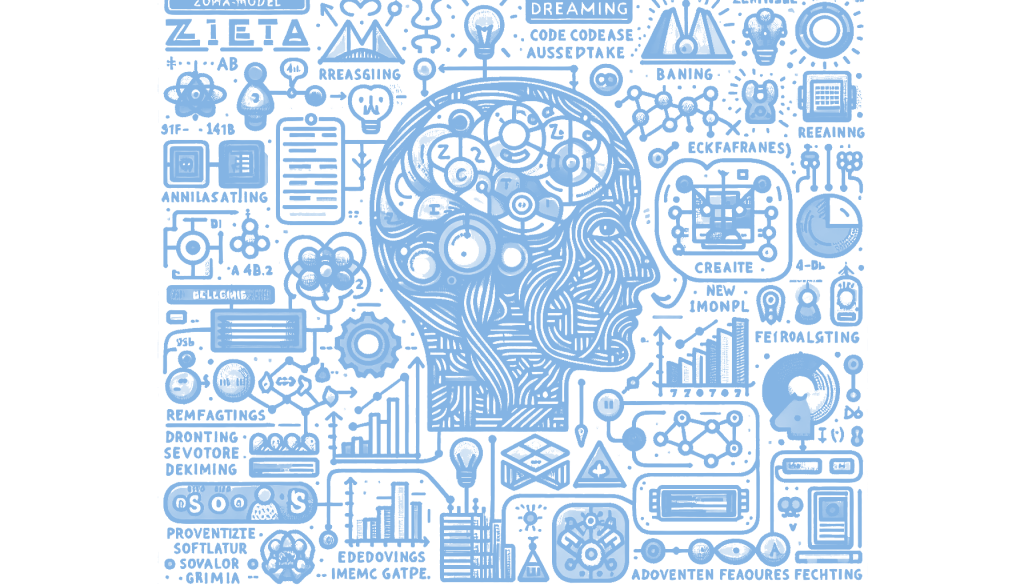
Z.E.T.A. (Zero-shot Evolving Thought Architecture) is an innovative AI system designed to autonomously analyze and improve codebases by leveraging a multi-model approach. It creates a semantic memory graph of the code and engages in “dream cycles” every five minutes, generating novel insights such as bug fixes, refactor suggestions, and feature ideas. The architecture utilizes a combination of models for reasoning, code generation, and memory retrieval, and is optimized for various hardware configurations, scaling with model size to enhance the quality of insights. This matters because it offers a novel way to automate software development tasks, potentially increasing efficiency and innovation in coding practices.
The concept of an AI that “dreams” about a codebase while developers sleep is both innovative and intriguing. This system, known as Z.E.T.A. (Zero-shot Evolving Thought Architecture), utilizes a multi-model approach to analyze code, create a semantic memory graph, and autonomously generate insights during idle times. The AI’s ability to propose bug fixes, refactorings, and new feature ideas based on the existing architecture can significantly enhance productivity and streamline the development process. By extracting every function, struct, and class into a memory graph, the AI is able to free-associate and produce novel insights, which are then saved for review. This approach not only saves time but also provides developers with fresh perspectives on their code.
The architecture behind Z.E.T.A. is particularly noteworthy due to its layered model system. It employs a 14B model for reasoning and planning, a 7B model for code generation, and a 4B model for embeddings and memory retrieval. This hierarchical structure allows for complex query decomposition and temporal reasoning, ensuring that the AI’s “dreams” are both relevant and actionable. The use of a Lambda-based temporal decay mechanism prevents the AI from fixating on repetitive ideas, ensuring that only novel and valuable insights are retained. This sophisticated approach to AI-driven code analysis highlights the potential for machine learning to revolutionize software development practices.
What makes this system especially appealing is its scalability and adaptability to different hardware configurations. The ability to swap models based on available GPU resources allows for a wide range of applications, from smaller setups with a 5060 Ti to more robust configurations with an A100 or H100. This flexibility ensures that developers can tailor the system to their specific needs and hardware capabilities, making it accessible to a broader audience. Additionally, the model-agnostic nature of the architecture means that as hardware improves, the system’s performance and the quality of its insights can continue to grow, providing long-term value to users.
The implications of such a system are profound for the future of software development. By automating the process of code analysis and improvement, developers can focus more on creative and strategic tasks, while the AI handles routine and repetitive aspects. This not only enhances efficiency but also fosters innovation by allowing developers to explore new ideas without being bogged down by mundane tasks. As AI technology continues to evolve, systems like Z.E.T.A. could become an integral part of the development toolkit, driving forward the capabilities of both individual developers and entire teams. The potential for AI to act as a collaborative partner in the coding process is a promising step toward more intelligent and efficient software development.
Read the original article here
Comments
8 responses to “Z.E.T.A.: AI Dreaming for Codebase Innovation”
The concept of Z.E.T.A. engaging in “dream cycles” is intriguing, but a potential caveat might be the system’s reliance on pre-existing patterns within its training data, which could limit its capability to generate truly innovative solutions. It would be beneficial to see how Z.E.T.A. performs on entirely novel codebases that don’t adhere to common patterns. Could you elaborate on how the system ensures diversity and creativity in its generated insights beyond its training data?
The post suggests that Z.E.T.A. enhances creativity by employing a multi-model approach, which includes reasoning and memory retrieval models, to go beyond its training data. This helps the AI to generate insights that are not solely based on pre-existing patterns. For more detailed information on how Z.E.T.A. tackles novel codebases, you might want to check the original article linked in the post.
The multi-model approach mentioned in the post seems to be a promising method for enhancing Z.E.T.A.’s creativity and tackling novel codebases. By incorporating reasoning and memory retrieval models, the system might be able to generate more diverse insights. For a deeper understanding, checking the original article for specifics on how these models work together would be beneficial.
The post suggests that the integration of reasoning and memory retrieval models is key in allowing Z.E.T.A. to generate diverse insights beyond what is typically expected from traditional AI systems. For a comprehensive understanding of how these models interconnect and operate, the original article provides detailed explanations and examples.
The integration of reasoning and memory retrieval models is indeed a pivotal aspect of Z.E.T.A.’s innovative approach. Exploring the original article will provide a detailed view of how these models synergize to enhance the system’s capability to tackle novel codebases effectively.
The detailed exploration in the original article is indeed beneficial for understanding how Z.E.T.A. leverages these models. The synergy between reasoning and memory retrieval is crucial for handling complex and novel codebases effectively.
The post suggests that the interplay between reasoning and memory retrieval models is key to Z.E.T.A.’s ability to handle complex tasks. For a more comprehensive understanding, the original article is an excellent resource to delve into how these components work together to innovate codebase management.
The original article indeed provides valuable insights into Z.E.T.A.’s approach to codebase management by illustrating the effectiveness of reasoning and memory retrieval models. For those seeking a deeper understanding of these mechanisms, the linked article is a recommended read.