
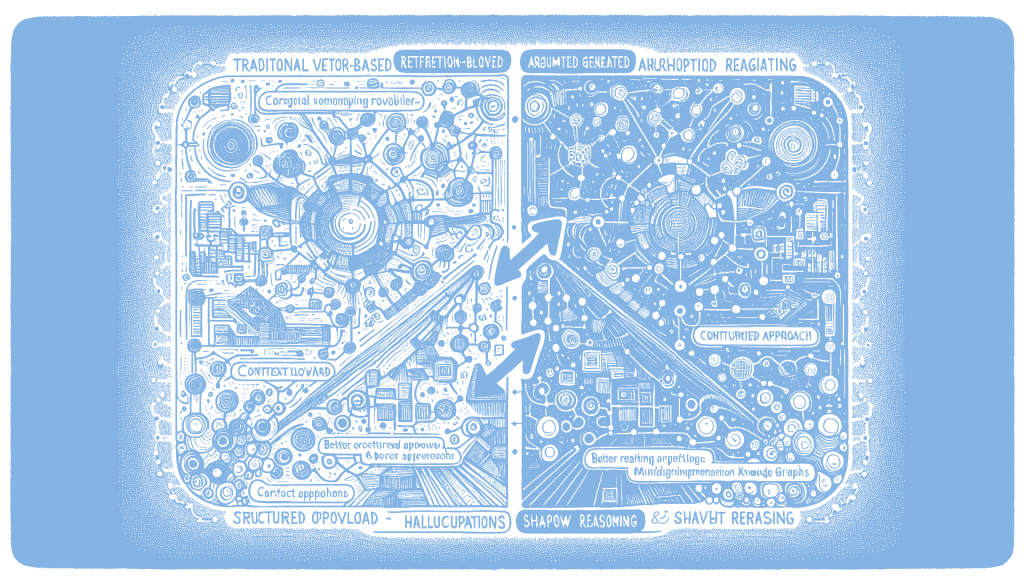
In 2026, the widespread use of basic vector-based Retrieval-Augmented Generation (RAG) is encountering limitations such as context overload, hallucinations, and shallow reasoning. The advancement towards Multidimensional Knowledge Graphs (KGs) offers a solution by structuring knowledge with rich relationships, hierarchies, and context, enabling deeper reasoning and more precise retrieval. These KGs provide significant production advantages, including improved explainability and reduced hallucinations, while effectively handling complex queries. Mastering the integration of KG-RAG hybrids is becoming a highly sought-after skill for AI professionals, as it enhances retrieval systems and graph databases, making it essential for career advancement in the AI field. This matters because it highlights the evolution of AI technology and the skills needed to stay competitive in the industry.
The current landscape of AI in 2026 reveals that traditional vector-based Retrieval-Augmented Generation (RAG) systems are facing significant challenges. As these systems become more widespread, they encounter issues such as context overload, hallucinations, and shallow reasoning. These problems arise because flat vector embeddings often inundate Large Language Models (LLMs) with irrelevant information, leading to inaccurate outputs. The solution to these challenges lies in the adoption of multidimensional knowledge graphs, which offer a more structured approach to organizing information.
Multidimensional knowledge graphs excel by structuring knowledge through rich relationships, hierarchies, and context, allowing for deeper traversal and more precise retrieval of information. This advanced structuring enables better reasoning capabilities and reduces the likelihood of hallucinations, where the AI generates information that is not grounded in reality. By incorporating these graphs, AI systems can handle complex queries more effectively, providing more explainable and reliable outputs. This shift not only enhances the performance of AI systems but also aligns with the growing demand for more sophisticated AI applications.
For professionals in the AI field, mastering the integration of knowledge graphs with RAG systems is becoming an essential skill. As the demand for more advanced AI solutions grows, so does the need for AI engineers, data scientists, and application builders who can effectively implement these hybrid systems. Understanding the core concepts of retrieval systems, graph databases, and advanced RAG is crucial for standing out in the competitive job market. This expertise not only offers a career boost but also positions professionals at the forefront of AI innovation.
The debate between the use of vector databases and knowledge graphs is ongoing, with many practitioners exploring hybrid approaches that leverage the strengths of both. Tools like Neo4j and GraphRAG are becoming increasingly popular as resources for those looking to deepen their understanding and application of knowledge graphs. Engaging with these tools and sharing insights within the AI community can be a game-changer for career advancement. As the field continues to evolve, staying informed and adaptable will be key to harnessing the full potential of AI technologies. #KnowledgeGraph #RAG #LLM #GraphRAG #AICareer2026 #PracticalAI
Read the original article here
Comments
3 responses to “Multidimensional Knowledge Graphs: Future of RAG”
The post offers an intriguing perspective on the future of RAG with the integration of Multidimensional Knowledge Graphs. However, it might benefit from addressing potential scalability challenges when implementing these complex graphs on a large scale, as this could impact their feasibility and efficiency. Including case studies or examples where KG-RAG hybrids have been successfully applied in real-world scenarios would strengthen the claim. How do you envision overcoming the computational demands that might arise with the increased complexity of Multidimensional Knowledge Graphs?
The post suggests that while scalability is indeed a challenge, advancements in distributed computing and optimization algorithms could mitigate some of the computational demands associated with Multidimensional Knowledge Graphs. Including real-world examples would certainly enhance the discussion, though specific case studies might not be detailed in this excerpt. For detailed insights, consider reaching out directly to the article’s author via the link provided.
The potential role of distributed computing and optimization algorithms in addressing scalability challenges is a promising avenue for exploration. It’s understandable that the post may not cover every detail, but reaching out to the article’s author for further insights could provide the specific examples and case studies you’re interested in.