
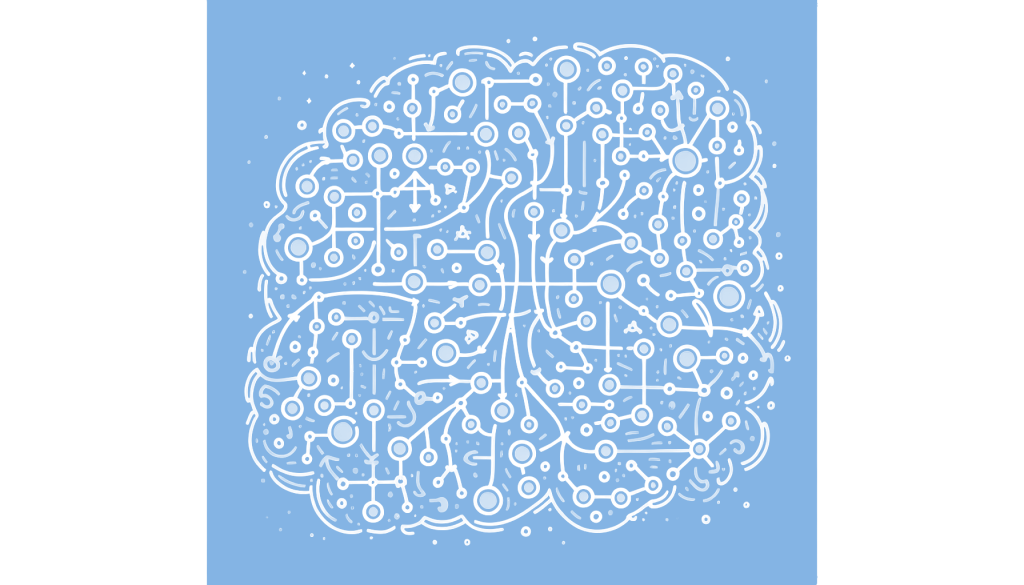
Neural networks often suffer from overfitting, where they memorize training data instead of learning generalizable patterns, especially as they become deeper and more complex. Traditional regularization methods like L2 regularization and early stopping can fall short in addressing this issue. In 2012, Geoffrey Hinton and his team introduced dropout, a novel technique where neurons are randomly deactivated during training, preventing any single pathway from dominating the learning process. This approach not only limits overfitting but also encourages the development of distributed and resilient representations, making dropout a pivotal method in enhancing the robustness and adaptability of deep learning models. Why this matters: Dropout is crucial for improving the generalization and performance of deep neural networks, which are foundational to many modern AI applications.
Overfitting is a significant challenge in the world of neural networks, where a model performs exceptionally well on training data but fails to generalize to new, unseen data. This problem arises when models become too complex and start memorizing the training data instead of identifying the underlying patterns. As neural networks grow deeper and more intricate, with millions of parameters, they become even more susceptible to this issue. Traditional regularization methods like L2 regularization and early stopping provide some relief but often fall short for very deep networks. This highlights the need for more robust solutions to ensure models can generalize well.
Enter dropout, a method introduced by Geoffrey Hinton and his students in 2012, which revolutionized regularization in deep learning. The concept is simple yet powerful: during training, neurons are randomly deactivated or “dropped out.” This intentional weakening of the network prevents any single pathway from becoming dominant, forcing the model to adapt to missing components. As a result, dropout encourages redundancy and robustness within the network, leading to more generalizable models. By incorporating randomness into the training process, dropout effectively mitigates the risk of overfitting.
Beyond just limiting overfitting, dropout fundamentally alters the way neural networks learn. By compelling models to develop distributed and resilient representations, dropout fosters a more holistic understanding of the data. This means that instead of relying on specific pathways, the model learns to leverage a broader set of features, enhancing its ability to generalize to new data. The technique has become one of the most effective and influential regularization strategies in deep learning, demonstrating its value across various applications and architectures.
The importance of dropout cannot be overstated in the context of modern machine learning. As models continue to grow in complexity, ensuring they remain capable of generalizing beyond their training data is crucial. Dropout provides a straightforward yet powerful tool to achieve this, making it a staple in the toolkit of machine learning practitioners. By embracing randomness and encouraging redundancy, dropout not only addresses the overfitting problem but also enriches the learning process, leading to more robust and adaptable neural networks. This matters because it enables the development of models that are not only powerful but also reliable and versatile in real-world applications.
Read the original article here
Comments
8 responses to “Dropout: Regularization Through Randomness”
Dropout truly revolutionizes how neural networks handle overfitting by introducing randomness that forces the model to learn more robust features. It cleverly breaks the reliance on specific neurons and pathways, allowing the network to generalize better across unseen data. How does dropout interact with other regularization techniques like batch normalization, and are there scenarios where it might be less effective?
Dropout indeed plays a significant role in promoting robustness by reducing overfitting. When used alongside batch normalization, dropout can still be effective, though the order of application—typically applying dropout after batch normalization—can influence outcomes. However, in scenarios where the model has limited capacity or where data is extremely scarce, dropout might be less beneficial, as it could overly hinder the learning process. For more detailed insights, consider checking the original article linked in the post.
The post suggests that applying dropout after batch normalization can help maintain the benefits of both techniques, though careful tuning is essential to avoid potential conflicts. In cases of limited model capacity or scarce data, the article indicates that dropout might not always be the optimal choice, as it could impede effective learning. For more specifics, referring to the original article linked in the post would be beneficial.
It’s insightful to note the interplay between dropout and batch normalization, as their sequence can indeed affect model performance. In cases with limited capacity or scarce data, it might be more prudent to explore alternative regularization methods that align better with the model’s constraints. For further details, referring to the original article could provide additional clarity.
The post suggests that alternative regularization methods, such as L2 regularization or early stopping, might be more suitable for models with limited capacity or when working with scarce data. For a deeper understanding, referring to the original article could indeed provide more comprehensive insights.
The post indeed highlights L2 regularization and early stopping as viable alternatives, particularly in scenarios where dropout might not be optimal. Exploring these methods could offer more tailored solutions for models with specific constraints. For any uncertainties, it’s best to review the original article linked in the post for more detailed guidance.
It’s great to see the discussion around choosing the right regularization methods. The original article should indeed provide further clarity on when alternatives like L2 regularization or early stopping might be more effective, based on the specific needs of your model and data.
The post suggests that understanding the specific characteristics of your model and data can guide the choice of regularization technique. If you’re looking for more in-depth insights, the original article is a great resource to delve into these alternatives further.